AAP has developed one-page immunization fact sheets intended to supplement, but not replace, the CDC Vaccine Information Statements (VISs) for vaccines given to children. VISs are required by federal law to be provided for all vaccines covered by the National Vaccine Injury Compensation Program, which includes all vaccines routinely recommended for children or during pregnancy.
The fact sheets, some of which are available in Spanish, can be downloaded at no cost from the AAP website at www.aap.org/en/patient-care/immunizations/immunization-fact-sheets/.
Last reviewed:
September 23, 2026
All COVID-19 vaccines are administered intramuscularly. Preparation details and dose volume vary by product. Most 2025-2026 formula products are now available in manufacturer-filled syringes.
Last reviewed:
November 16, 2025
Yes. CDC published an appendix to its interim clinical considerations for the use of COVID-19 vaccines to address a wide range of errors in vaccine administration. It includes a detailed table outlining actions to take after an error has occurred: www.cdc.gov/covid/hcp/vaccine-considerations/appendices.html.
Categories of errors covered in the CDC table include:
- Site/route
- Age
- Product and dosage
- Storage and handling
- Incorrect intervals
- Interchanging product types when not recommended
Ask the Experts refers our readers to this CDC table for the most current and comprehensive guidance on COVID-19 vaccine administration errors and how to manage them. For all vaccine administration errors the following steps are recommended: inform the patient of the error, report the error to VAERS (https://vaers.hhs.gov) unless CDC’s guidance states that the error does not need to be reported, evaluate why the error occurred, and implement strategies to prevent future errors.
Last reviewed:
November 16, 2025
No. CDC does not recommend repeating the dose of any COVID-19 vaccine in circumstances where the dose is administered in an incorrect route or an incorrect site (i.e., not in the deltoid or anterolateral thigh). In the case of a subcutaneous injection, the patient should be advised of the possibility of self-limited local or systemic side effects.
Last reviewed:
November 16, 2025
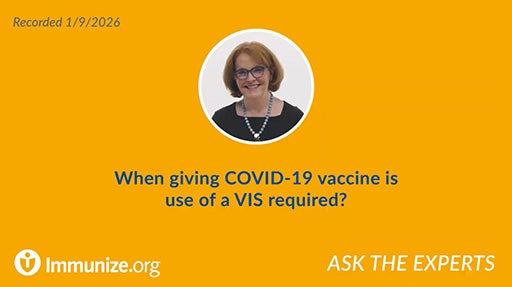
Providing a vaccine recipient with a COVID-19 vaccine VIS is recommended by CDC but not required. The requirement to provide the VIS to a patient is present only when a vaccine is included in the federal Vaccine Injury Compensation Program (VICP). COVID-19 vaccines are not included in the VICP at this time. The current official VIS and all available translations are available from Immunize.org: www.immunize.org/vaccines/vis/covid-19/.
Last reviewed:
November 16, 2025
Last reviewed:
January 9, 2026
Vaccinating people against influenza who have recently tested positive for COVID-19 involves multiple considerations, such as whether vaccinating them could expose others to COVID-19, how sick they are, their risk for severe influenza illness, the ability to vaccinate at a later date, and the desire to avoid confusing postvaccination symptoms with those of COVID-19. Usually, people who are known to be infectious should not be brought to a vaccination setting if doing so could expose others to COVID-19. Any moderate or severe acute illness is a precaution to influenza vaccination: vaccination should generally be deferred until recovery. For people with mild or asymptomatic COVID-19, delaying vaccination also might be considered to avoid confusing COVID-19 symptoms with postvaccination reactions.
Last reviewed:
October 11, 2026