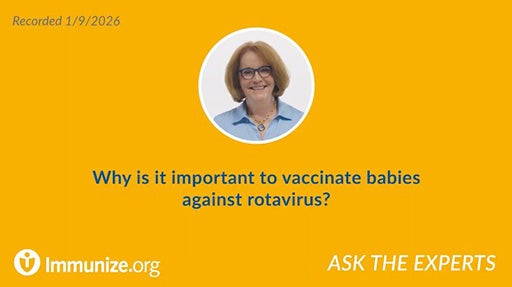
Before rotavirus vaccines were available, rotavirus was the most common cause of severe gastroenteritis in infants and young children in the United States and worldwide. Almost all children were infected by age 5 years. Before vaccine was introduced in the United States, rotavirus was responsible each year for about 3 million episodes of gastroenteritis, 410,000 physician visits, 205,000–272,000 emergency department visits, 55,000–70,000 hospitalizations, and between 20 and 60 deaths among children younger than age 5 years.
Last reviewed:
June 7, 2023
Last reviewed:
January 9, 2026
Rotavirus is contagious and the infection is usually spread from person to person, through the fecal-oral route. Fecal-oral transmission occurs when bacteria or viruses found in the stool of one person are swallowed by another person. This can occur when small amounts of fecal matter may be found on surfaces such as toys, books, clothing, etc. and on the hands of parents or child-care providers; but are usually invisible. Rotavirus may also be transmitted through intake of fecally-contaminated water or food or by respiratory droplets that people sneeze, cough, drip, or exhale. Rates of the illness among children in developed and less developed countries are similar.
Last reviewed:
June 7, 2023
Yes. Rotavirus infection of adults is usually asymptomatic but may cause diarrheal illness. Outbreaks of diarrheal illness caused by rotavirus have been reported, especially among elderly persons living in retirement communities. For more information on this issue see www.cdc.gov/mmwr/pdf/wk/mm6042.pdf, page 1456.
Last reviewed:
June 7, 2023
Advisory Committee on Immunization Practices (ACIP) recommendations for use of rotavirus vaccines are available at www.cdc.gov/mmwr/PDF/rr/rr5802.pdf.
Last reviewed:
June 7, 2023
Two rotavirus vaccines are available in the United States. RotaTeq (RV5; Merck) is recommended for routine oral administration for all infants as a 3-dose series. The usual schedule is at ages 2, 4, and 6 months. Rotarix (RV1; GlaxoSmithKline) is recommended as a 2-dose series at ages 2 and 4 months.
The minimum interval between doses of rotavirus vaccine is 4 weeks. The minimum age for the first dose is 6 weeks and the maximum age for dose #1 is 14 weeks 6 days. Vaccination should not be initiated for infants age 15 weeks 0 days or older because there are insufficient data on the safety of dose #1 in older infants. The maximum age for the last dose of rotavirus vaccine is 8 months and 0 days.
Last reviewed:
June 7, 2023
The two rotavirus vaccine products differ in composition and schedule of administration. RotaTeq was approved by the Food and Drug Administration (FDA) in 2006. It contains five reassortant rotaviruses developed from human and bovine parent rotavirus strains; 3 doses are given in the series. Rotarix was approved by the FDA in 2008 and contains an attenuated human rotavirus strain; 2 doses are given in the series.
Last reviewed:
June 7, 2023
ACIP recommendations and package inserts do not always match. Occasionally, ACIP may use different data to formulate its recommendations, or try to add flexibility to its recommendations (as was the case in this situation), which results in a recommendation different than the package insert. Published recommendations of national advisory groups (such as ACIP or AAP’s Committee on Infectious Diseases) should be considered equally as authoritative as those on the package insert. You should consider 8 months 0 days as the maximum age for a dose of rotavirus vaccine.
Last reviewed:
June 7, 2023
ACIP recommends that the rotavirus vaccine series be completed with the same product whenever possible. However, vaccination should not be deferred because the product used for a previous dose is not available or is unknown. In these situations, the provider should continue or complete the series with the product available. If any dose in the series was RotaTeq, or the vaccine product is unknown for any dose in the series, a total of 3 doses of rotavirus vaccine should be administered. The minimum interval between doses of rotavirus vaccine is 4 weeks. All doses should be administered by age 8 months and 0 days.
Last reviewed:
June 7, 2023
ACIP recommends that infants who have had rotavirus gastroenteritis before receiving the full series of rotavirus vaccination should still start or complete the schedule according to the age and interval recommendations because the initial rotavirus infection might provide only partial protection against subsequent rotavirus disease.
Last reviewed:
June 7, 2023
ACIP supports vaccination of preterm infants according to the same schedule and precautions as full-term infants and under the following conditions: if the infant’s chronological age meets the age requirements for rotavirus vaccine (for example, age 6 weeks to 14 weeks 6 days for dose #1), the infant is clinically stable, and the vaccine is administered at the time of discharge from the hospital or after discharge from the hospital.
Last reviewed:
June 7, 2023
ACIP recommends vaccination of preterm infants according to the same schedule and precautions as full-term infants. In preterm infants (as in full-term infants), the maximum chronological age for the first dose is 14 weeks 6 days. Vaccination should not be initiated for infants aged 15 weeks 0 days or older because of insufficient data on safety of dose 1 of rotavirus vaccine in older infants. For more information, see page 19 of ACIP’s recommendations on rotavirus vaccination, available at www.cdc.gov/mmwr/PDF/rr/rr5802.pdf.
Last reviewed:
June 7, 2023
If the product used for a previous dose is unknown, and the infant is at an age when the vaccine can still be given, give a total of 3 doses of rotavirus vaccine. All doses should be administered by age 8 months and 0 days.
Last reviewed:
June 7, 2023
Infants for whom the first dose of rotavirus vaccine was inadvertently administered at age 15 weeks or older should receive the remaining doses of the series at the routinely recommended intervals. Timing of the first dose should not affect the safety and efficacy of the remaining doses. Rotavirus vaccine should not be given after age 8 months 0 days even if the series is incomplete.
Last reviewed:
June 7, 2023
Try to follow general guidelines for oral administration of liquid vaccines. First, give this vaccine at the beginning of the office visit, while the baby is still happy, and before you administer injections or perform other procedures. Second, make every effort to aim the dropper containing the vaccine down one side and toward the back of the child’s mouth. Don’t put the dropper so far back that you gag the child. You may find the following information from the RotaTeq manufacturer helpful: www.merckvaccines.com/rotateq/dosage-and-administration. You can also find a pictorial description of both reconstitution and administration of the lyophilized formulation of Rotarix at www.rotarixhcp.com/dosage/administration.
Last reviewed:
June 7, 2023
The manufacturer has not addressed this issue but CDC considers administration of rotavirus vaccine via gastrostomy tube to be acceptable practice. There should be no problem flushing the tube after vaccine has been administered.
Last reviewed:
June 7, 2023
Yes. The effectiveness concerns with antibody-containing blood products (ACBP) do not apply to rotavirus vaccine, since it is administered orally and replication of the vaccine virus occurs in the GI tract, “separate” from the site of the ACBP. Note that the child should be carefully screened for other potential contraindications or precautions to vaccination since administration of immune globulin could indicate immunosuppression.
Last reviewed:
June 7, 2023
The rotavirus vaccine dose given by the intramuscular route is not valid and should be repeated by the oral route as soon as possible. In a review of this type of rotavirus vaccine administration error, there usually were not adverse reactions, and those documented were limited to local reactions and general, brief irritability. Please see www.cdc.gov/mmwr/pdf/wk/mm6304.pdf, page 81, for more information.
Please take steps to ensure that such vaccine administration errors are avoided in the future. This event should be reported to the Vaccine Adverse Event Reporting System at https://vaers.hhs.gov even if an adverse reaction does not result from it.
Last reviewed:
February 27, 2025
Yes. Rotavirus vaccine virus is shed during the first weeks after administration of rotavirus vaccine. Handwashing after diaper changing is always recommended.
Last reviewed:
June 7, 2023
Do not give rotavirus vaccine to an infant who has a history of a severe allergic reaction (for example, anaphylaxis) after a previous dose of rotavirus vaccine or to a vaccine component. The oral applicator for Rotarix contains natural latex rubber so infants with a severe (anaphylactic) allergy to latex should not be given Rotarix; the RotaTeq (Merck) dosing tube is latex-free. Rotavirus vaccine is contraindicated in infants with the rare disorder severe combined immunodeficiency (SCID) and in infants with a history of intussusception.
Practitioners should consider the potential risks and benefits of administering rotavirus vaccine to infants with known or suspected altered immunocompetence, including those whose mothers received immunosuppressive biologics (such as infliximab) during pregnancy. Consultation with an immunologist or infectious diseases specialist is advised.
Children and adults who are immunocompromised because of congenital immunodeficiency, hematopoietic stem cell transplantation, or solid organ transplantation sometimes experience severe or prolonged rotavirus gastroenteritis. However, few safety or efficacy data are available for the administration of rotavirus vaccine to infants who are immunocompromised or potentially immunocompromised, including 1) infants with primary and acquired immunodeficiency, cellular immunodeficiency, and hypogammaglobulinemia and dysgammaglobulinemia; 2) infants with blood dyscrasias, leukemia, lymphomas, or other malignant neoplasms affecting the bone marrow or lymphatic system; 3) infants on immunosuppressive therapy (including high-dose systemic corticosteroids); and 4) infants who are HIV-exposed or infected.
Last reviewed:
June 7, 2023
Infliximab is an IgG monoclonal antibody that neutralizes the biological activity of tumor necrosis factor-alpha. Like other IgG antibodies infliximab crosses the placenta. Infliximab has been detected in the blood of infants up to 6 months following birth. Consequently, these infants may be at increased risk of serious infection.
Neither ACIP nor CDC provides specific guidance on this issue because there are few data on safety or efficacy in children exposed to potentially immunosuppressive biologics during pregnancy. As noted above, practitioners should consider the potential risks and benefits of administering rotavirus vaccine to infants with known or suspected altered immunocompetence. Consultation with an immunologist or infectious diseases specialist is advised.
The manufacturer recommends that live vaccines (rotavirus and BCG) be deferred for at least six months after birth for infants whose mothers received infliximab during pregnancy. Hence, if a practitioner follows the manufacturer’s recommendation the child would not be eligible to receive rotavirus vaccine because according to ACIP guidelines the rotavirus vaccine series should not to be started after age 15 weeks 0 days.
Inactivated vaccines should be given on schedule.
Last reviewed:
June 7, 2023
Having an immunocompromised household contact is not usually a reason for delaying routine vaccination for others in the household. Rotavirus vaccine should be administered to susceptible household contacts and other close contacts of immunocompromised patients when indicated. All members of the household should wash their hands after changing the diaper of an infant. This minimizes rotavirus transmission from an infant who received rotavirus vaccine. Additional information on this topic can be found in the ACIP “General Best Practice Guidelines for Immunization”, available at www.cdc.gov/vaccines/hcp/imz-best-practices/altered-immunocompetence.html.
Last reviewed:
June 7, 2023
In the RotaTeq clinical trials in the first week after any dose vaccine recipients had a small but statistically significant increased rate of diarrhea (18.1% in the RotaTeq group, 15.3% in the placebo group) and vomiting (11.6% in the RotaTeq group, 9.9% in the placebo group). During the 42-day period following any dose, statistically significantly greater rates of diarrhea, vomiting, otitis media, nasopharyngitis and bronchospasm occurred in RotaTeq recipients compared with placebo recipients.
In the Rotarix clinical trials, in the first week after vaccination, Grade 3 (i.e., those that prevented normal everyday activities) cough or runny nose occurred at a slightly but statistically higher rate in the Rotarix group (3.6 %) compared with placebo group (3.2%). During the 31-day period after vaccination, these unsolicited adverse events occurred at a statistically higher incidence among vaccine recipients: irritability (11.4% in Rotarix group, 8.7% in placebo group) and flatulence (2.2% in Rotarix group, 1.3% in placebo group).
In clinical trials of both vaccines the occurrence of intussusception was studied very carefully; see the separate question and answer on this topic.
Last reviewed:
June 7, 2023
Large pre-licensure clinical trials of both RotaTeq and Rotarix did not find an increased risk for intussusception among vaccine recipients. A large post-licensure study of more than 1.2 million rotavirus vaccine recipients found a very small increased risk of intussusception (1 to 1.5 additional cases of intussusception per 100,000 vaccinated infants) in the 7 to 21 days following the first dose. No increased risk of intussusception was found after the second or third doses. CDC and the Food and Drug Administration (FDA) continue to believe that the benefits of rotavirus vaccination outweigh the risks associated with vaccination and that routine vaccination of infants should continue.
A study conducted by the CDC Vaccine Safety Datalink (VSD) between May 2006 to February 2010 found no increased risk of intussusception following vaccination with RotaTeq. However, the study indicated an increased risk of intussusception following dose 1 and dose 2 of Rotarix. CDC estimates that there is a small increased risk of intussusception, usually within the first week after dose 1 or dose 2 of rotavirus vaccine, resulting in one additional case for every 20,000 to 100,000 U.S. infants who receive the vaccine.
Last reviewed:
June 7, 2023
Both vaccines should be stored at refrigerator temperature and protected from light. Do not administer the vaccine if it has been frozen or exposed to freezing temperatures.
Last reviewed:
June 7, 2023