Link copied
- RSV (Respiratory Syncytial Virus)
- Vaccine Recommendations during Pregnancy
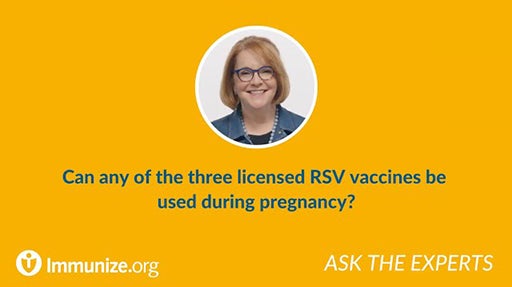
Can any of the three licensed RSV vaccines be used during pregnancy? [Video]
Last reviewed:
August 24, 2025

Pregnant patients between 32 and 36 weeks and 6 days’ gestation during the months of September through January in the United States should get one dose of the Pfizer RSVpreF vaccine (Abrysvo) to protect their babies during their first RSV season after birth. Only Abrysvo is FDA-approved and recommended for pregnant patients. Arexvy (by GSK) and mResvia (Moderna) are not approved and should not be given during pregnancy.
In most of the continental United States, maternal RSV vaccine is recommended only September through January. Those who provide health care to pregnant patients who live in areas with different patterns of RSV seasonality, such as Alaska, Hawaii, parts of Florida, or other jurisdictions outside the continental United States, should follow guidance from state or territorial public health authorities about the timing of RSV vaccination during pregnancy in their regions.
RSV vaccine is only recommended as a single dose; revaccination is not recommended. However, RSV vaccination during one pregnancy is not expected to protect infants resulting from future pregnancies. Therefore, a patient who is currently pregnant and received RSV vaccine before the current pregnancy should be counseled that their infant should be immunized with an RSV preventive antibody for protection against RSV disease after birth.
No. Only the Pfizer (Abrysvo) RSV vaccine is recommended during pregnancy. The GSK RSV vaccine (Arexvy) and the Moderna vaccine (mResvia) are not licensed or recommended for use in pregnancy.
If Arexvy or mResvia is inadvertently administered during pregnancy, do NOT administer a dose of Abrysvo. Instead, CDC recommends that the infant (if younger than 8 months) should be immunized with an RSV preventive antibody product during RSV season (generally October through March in most of the continental United States). Treat the infant in the same manner as an infant born to a mother who did not receive RSV vaccination during pregnancy.
CDC strongly urges that this type of administration error be reported to the Vaccine Adverse Event Reporting System, VAERS (https://vaers.hhs.gov). Prevent administration errors with health care provider training on the different indications for each RSV prevention product (both vaccines and the preventive antibody products for infants) and always check product labels at least three times before administration to verify that the correct product is being administered to the patient. Consider implementing other feasible safeguards in your system (e.g., electronic alerts) to prevent such errors.
No. RSV vaccination during pregnancy is only recommended for pregnant people who have not previously received an RSV vaccine and who are at the recommended stage of pregnancy (32 weeks through 36 weeks 6 days’ gestation) during the recommended time of year (typically September through January). In regions with seasonal patterns of RSV that differ from the continental United States, such as Alaska, Hawaii, or subtropical parts of Florida, follow state or territorial public health guidance on timing, which may differ.
Yes. Pfizer’s RSV vaccine (Abrysvo) may be administered to a previously unvaccinated pregnant person from 32 weeks through 36 weeks and 6 days’ gestation. RSV vaccine should not be administered to someone at 37 weeks’ gestation or beyond.
RSV vaccine should be administered at least 2 weeks before delivery to allow time for the maternal immune system to create antibodies and transfer sufficient antibodies to the fetus for adequate protection after birth. If the gestational age is appropriate, but clinical judgment is that delivery is likely to occur within 2 weeks, it is reasonable to defer vaccination and plan to immunize the infant with an RSV preventive antibody product after delivery. Infants born less than 14 days after maternal RSV vaccination are recommended to be immunized with an RSV preventive antibody product after birth to ensure adequate protection.
Many pregnant people will have a choice about whether to get Abrysvo during pregnancy or to immunize their infant with an RSV preventive antibody product after birth. Those who are previously unvaccinated and between 32 and 36 weeks 6 days’ gestation between September and January, may be vaccinated with Abrysvo or have their infant receive an RSV preventive antibody product soon after birth (preferably within the first week of life if born during a month when RSV preventive antibody product administration is recommended).
It is important to note that both Abrysvo RSV vaccine and RSV preventive antibody products may not be available or an option for all people in all settings. In some facilities or circumstances, only one option might be available: those offered Abrysvo during pregnancy may not wish to defer that option unless they are confident that an RSV preventive antibody product will be available for their infant. Conversely, if the pregnant person received RSV vaccine before the current pregnancy, only an RSV preventive antibody product administered after birth is recommended for RSV prevention. All infants up to 8 months 0 days of age whose mothers were not vaccinated may be given an RSV preventive antibody product when feasible, before or during their first RSV season.
Yes. VFC-eligible pregnant adolescents younger than age 19 may receive VFC-funded Abrysvo (Pfizer) RSV vaccine during pregnancy, if indicated, in VFC-participating facilities. Contact your state or territorial immunization program with questions about VFC and Abrysvo.