

- Immunize.org releases new resource summarizing COVID-19 vaccine dosing schedules for immunocompromised people
- Immunize.org updates “Vaccine Storage Quick Reference”
- Respiratory diseases: Influenza activity climbs nationwide; don’t hesitate—vaccinate!
- Measles 2026: Johns Hopkins University reports 5,051 confirmed cases; already more than twice last year’s total
- “Should Someone Who Has Already Had Shingles Get the Shingles Vaccine?” New in the Ask the Experts Video Series on YouTube.
- Vaccines in the news
- Spotlight on the LetsGetRealAboutVaccines.org website: Share the Facts
- Summary: these updated Immunize.org educational materials for clinicians were released during September and October
- Recap: Immunize.org updates Ask the Experts web section on COVID-19 to incorporate 2026 guidance from medical societies and CDC
- North Dakota State University Center for Immunization Research and Education launches 2026–2027 Respiratory Virus Season Social Media Toolkit
- Busy with influenza vaccinations? Need VIS translations? Download and print Immunize.org’s free QR code table that links directly to all injectable influenza VIS translations.
- Explore the www.Give2MenACWY.org website to increase uptake for the MenACWY booster and other adolescent vaccinations
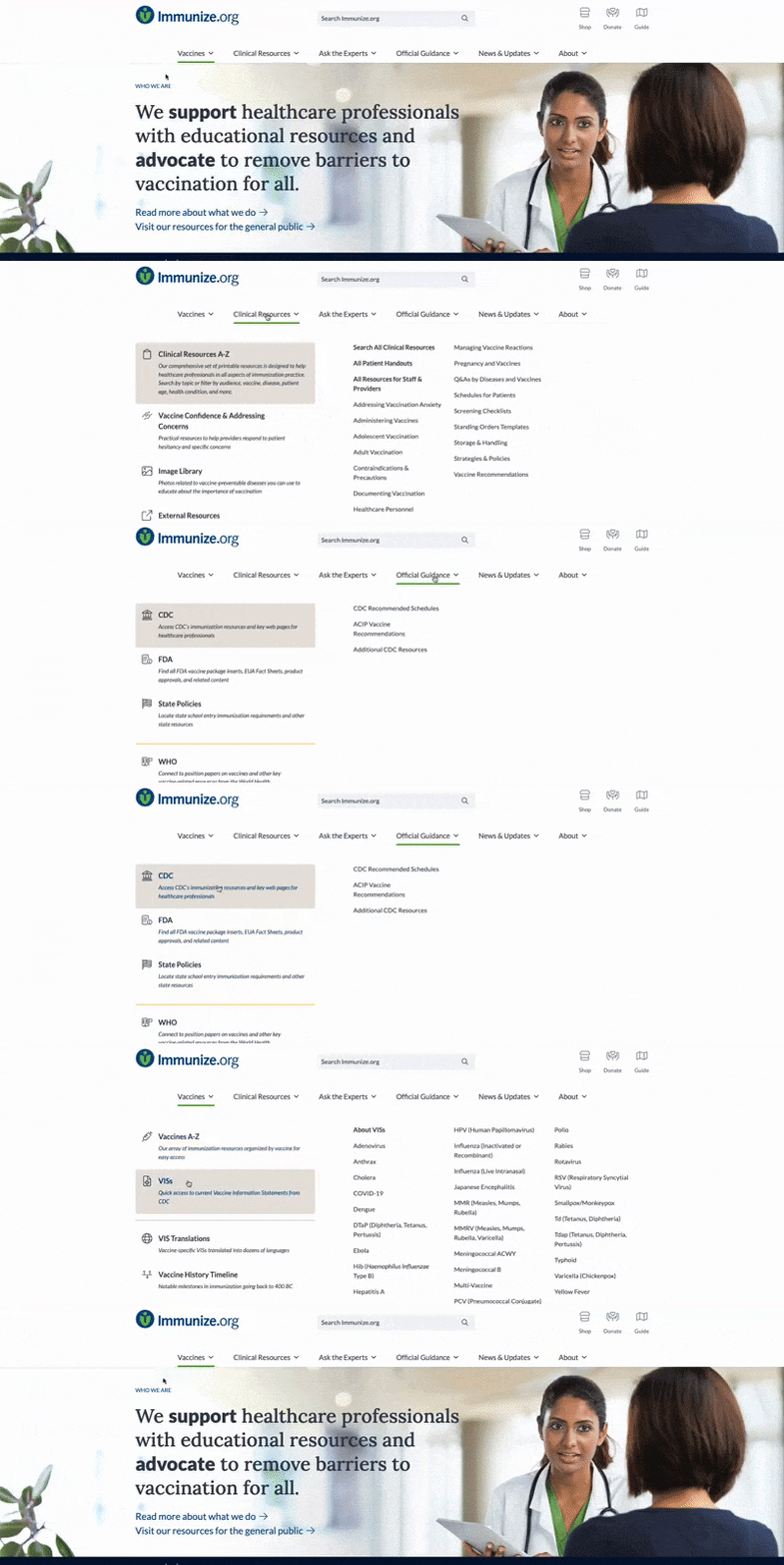
- Virtual: Register for Immunize.org Website Office Hours. Join a 30-minute discussion about the VIS web section on November 11 at 4:00 p.m. (ET) or November 12 at 12:00 p.m. (ET). Recorded sessions archived.
- Virtual: CHOP’s Current Issues in Vaccines webinar for healthcare providers on December 9 features Dr. Paul Offit discussing mRNA influenza vaccine; CE credit offered
Immunize.org released a new resource titled 2026–2027 COVID-19 Vaccination of People with Moderate or Severe Immunocompromise. People of all ages who meet the conditions for moderate or severe immunocompromise require an initial COVID-19 vaccination series, followed by one or more doses each season thereafter. CDC routinely recommends all those who have completed the initial series receive two current season doses 6 months apart. Infectious Diseases Society of America (IDSA) recommends a single dose, and notes that an additional dose likely extends protection. Both CDC and IDSA provide vaccination timing considerations focused on balancing the environmental risk of exposure to SARS-CoV-2 virus and the timing of immunocompromising treatments.
This resource is intended as a reference for those who vaccinate people who are moderately or severely immunocompromised. These dosing schedules are not included in the Immunize.org standing orders templates for COVID-19 vaccination. IDSA guidance refers to, but does not reproduce, the dosing tables. This downloadable 7-page resource provides the dosing schedules by age and prior vaccination status for each COVID-19 vaccine.
This resource was adapted from CDC's COVID-19 Vaccination Guidance for People Who Are Immunocompromised web page (dated 9/23/26). Additional clinical considerations are also included from the IDSA 2026 Guidelines on the Use of Vaccines for the Prevention of Seasonal COVID-19, Influenza, and RSV Infections in Immunocompromised Patients (dated 9/2/26).


Related Links
- Immunize.org: Vaccines A–Z: COVID-19 main page
- Immunize.org: Ask the Experts: COVID-19 web page
- Immunize.org: Clinical Resources: Seasonal Vaccines (Influenza, RSV, COVID)
Immunize.org recently updated Vaccine Storage Quick Reference to include updated storage information for mpox vaccine, RSV, and 2026–27 COVID-19 vaccine formulations.
Significant edits include:
- COVID-19 vaccine storage: Incorporates 2026–27 products and updates the relevant age ranges and refrigeration instructions.
- Mpox vaccine storage: Both Jynneos (Bavarian Nordic) 1-vial and 2-vial presentations are listed with their separate storage requirements. The 1-vial presentation has an allowable-refrigeration period of 4 weeks (some now-expired lots had FDA authorization for a longer refrigeration period).
- RSV vaccine storage: mResvia (Moderna) is listed under its label-indicated freezer temperature range (−40°C to −15°C), along with specific guidance allowing refrigeration for up to 90 days.
- RSV preventive antibody products: Both Beyfortus (nirsevimab, Sanofi) and Enflonsia (clesrovimab, Merck), are listed.
- Dengue vaccine: Dengvaxia (Sanofi) was removed because it is no longer manufactured and all U.S. doses expired.

Related Links
- Immunize.org: Clinical Resources: Storage & Handling main page
- Immunize.org: Clinical Resources: Administering Vaccines main page
- Immunize.org: Clinical Resources A–Z main page, where you can filter by topic, vaccine, language, or other criteria
For the week ending October 24, influenza activity is low and increasing in many parts of the United States. CDC notes that activity is higher than is typical for late October. CDC’s website displays two recent childhood deaths associated with influenza. For surveillance purposes, the standard start of the influenza season every year is week 40, so one child’s death (in week 40) is counted in the current season and the death that occurred 3 weeks earlier (in week 37) is counted in the previous season.
Vaccination takes 2 weeks to induce immunity, so vaccinate now. Influenza vaccination offers an opportunity to receive or schedule other vaccinations that may be needed, such as COVID-19, pneumococcal, and RSV vaccines.
The map below shows the levels of influenza-like illness (ILI) activity by state as of October 24. For the week ending October 24, overall, 2.4% of patient visits reported through ILINet were due to ILI. Compared to the previous week, this represents a small increase but remains below the national baseline of 2.9%.

COVID-19 vaccination is recommended annually for all adults, children age 6 months through 23 months, and older children who are immunocompromised, have other high-risk conditions, live with people with high-risk conditions, or who just want protection.
RSV vaccination is recommended for all adults age 75 years and older, as well as adults age 50 through 74 years at high risk of severe RSV disease. RSV vaccination between 32 and 36 6/7 weeks’ gestation is an option for RSV protection of newborns. If RSV vaccine is not administered during pregnancy, infants through age 8 months, 0 days, should receive RSV preventive antibodies (nirsevimab or clesrovimab). Remember that adults, including pregnant patients, who previously received RSV vaccine should not receive another dose.
Respiratory Illness Data Channel
CDC's Respiratory Illness Data Channel web page shows a snapshot of the amount of acute respiratory illness (ARI) causing people to seek health care in the United States. Local data are available by state or territory and by county. CDC reports:
- COVID-19: activity is declining nationally
- RSV: activity remains low in most areas of the country
Related Links
- CDC: Weekly National Flu Vaccination Dashboard main page
- CDC: FluView main page
- CDC: RESP-NET main page
- Immunize.org: Clinical Resources: Seasonal Vaccines (Influenza, RSV, COVID-19) main page
- VaccineInformation.org: Where to Get Vaccinated web page
As of October 30, 2026, the U.S. Measles Tracker, operated by Johns Hopkins University (JHU), reported 5,051 measles cases for 2026. Through October 29, 2026, CDC reported 4,852 confirmed cases, which is more than double the 2025 total of 2,289 confirmed cases.
Measles around the globe
According to a study published on October 21 in Nature Medicine, global measles cases among children younger than 5 years rose an estimated 40% between 2020 and 2023. Measles deaths among children in that age group increased 12% during the same period.
Pennsylvania outbreak and congenital measles
The Pennsylvania measles outbreak continues to grow. As of October 28, the 2026 count included 1,398 total cases and 85 new cases in the last 7 days. Most reported cases occurred among unvaccinated adults. Reports of measles during pregnancy also rose. Congenital measles is an unfamiliar condition in the United States. For important clinical guidance, please see the Pennsylvania Department of Health’s Health Alert Network (PAHAN) Advisory, entitled Guidance for Measles in Pregnancy and Congenital Measles.

Related Links
- CDC: Measles Cases and Outbreaks main page
- Immunize.org: Vaccines A–Z: Measles main page
- LetsGetRealAboutVaccines.org: Measles web page
- CDC: Be Ready for Measles Toolkit
- Pennsylvania Department of Health: Guidance for Measles in Pregnancy and Congenital Measles
- AAP: Immunization Facts for Families (MMR) (PDF)
“Should Someone Who Has Already Had Shingles Get the Shingles Vaccine?” New in the Ask the Experts Video Series on YouTube.
This week, our featured episode from the Ask the Experts Video Series is titled Should Someone Who Has Already Had Shingles Get the Shingles Vaccine? The video briefly explains that adults who previously suffered shingles should still receive Shingrix vaccination when recommended to reduce their risk of future episodes. A person with an active case of shingles should delay vaccination until the acute phase of shingles resolves.
The 1-minute video is available on our YouTube channel, along with our full collection of quick video answers to popular Ask the Experts questions.

Like, follow, and share Immunize.org’s social media accounts and encourage colleagues and others interested in vaccination to do likewise.
- Facebook at ImmunizeOrg
- Instagram at ImmunizeOrg
- LinkedIn at ImmunizeOrg
- YouTube at ImmunizeOrg
These recent articles convey the potential risks of vaccine-preventable diseases and the benefits of vaccination.
- Washington Post: CDC Scientists Sought Urgent Alert on Measles in Pregnancy. It Wasn’t Approved. (10/30/26)
- CIDRAP: A Cancer Vaccine Milestone, a Vaccine Injury Center, and What a Flu Shot Study Actually Found: The State of US Vaccine Policy (10/29/26)
- Medscape: Without Flu Vaccination, the US Could See Substantially More Deaths and Hospitalizations Annually (10/28/26)
- STAT: NIH’s New Vaccine Injury Center Has Broad Goals Beyond RFK Jr.’s Focus on Shots (10/26/26)
- BBC: First Personalised Cancer Vaccine Cuts Risk of Disease Returning in Major Trial (10/23/26)

This week, we continue to spotlight our website, LetsGetRealAboutVaccines.org, a trustworthy, parent-friendly platform that provides factual vaccine guidance. It equips families and providers with tools to discuss childhood immunization confidently.
The Share the Facts section, found at the third menu tab, offers sharable resources explaining the benefits of vaccines. Resources include fact sheets, social media graphics, videos, and infographics.

The main page includes the full list and preview of 100 resources that can be filtered by audience, topic, and format. Each item can be viewed, downloaded, or shared directly to social media.

Three supporting pages are available from this page and from the menu:
- Parent and Provider Stories: stories from real parents and healthcare providers who choose to vaccinate
- Watch PSA Videos: short public service announcement videos promoting the LetsGetRealAboutVaccines.org website
- Sharing Your Support: easy ways for parents to share support for vaccines on social media
Please share these links with anyone seeking credible, unbiased information about childhood vaccines.
View our archived webinar, Website Office Hours: Websites for the Public: VaccineInformation.org and LetsGetRealAboutVaccines.org, to take an informational tour of both affiliated websites and to learn how to use the websites efficiently.
Summary: these updated Immunize.org educational materials for clinicians were released during September and October
IZ Express regularly provides readers with information about Immunize.org’s new and updated educational materials for healthcare professionals and handouts for patients. All Immunize.org materials are free to distribute.
If you missed them, the following materials were posted in recent weeks.
Clinical Resources to Administer and Screen:
- How to Administer Intranasal and Oral Vaccinations
- How to Administer Intramuscular and Subcutaneous Vaccine Injections
- Vaccines with Diluents: How to Use Them
- Screening Checklist for Contraindications to Vaccines for Children and Teens, available in 17 translations
- Screening Checklist for Contraindications to Vaccines to Adults, available in 17 translations
- Standing Orders for Administering Meningococcal ACWY Vaccine to Children and Teens
- Meningococcal ACWY Vaccines by Age and Risk Factor
COVID-19 Related Clinical Resources:
Standing Orders Templates for Administering:
- 2026–2027 COVID-19 Vaccine to Adults 19 Years and Older
- 2026–2027 COVID-19 Vaccine to Children 6 Months Through 18 Years
- Checklist of Current Versions of U.S. COVID-19 Vaccination Guidance and Clinic Support Tools
RSV-Related Clinical Resources:
Standing Orders Templates for Administering:
- Respiratory Syncytial Virus Vaccine (RSV) to Adults Age 50 Years and Older
- Pfizer Respiratory Syncytial Virus (RSV) Vaccine (Abrysvo) During Pregnancy
- Nirsevimab RSV Preventive Antibody (Beyfortus, by Sanofi) to Infants and High-Risk Young Children
- Clesrovimab RSV Preventive Antibody (Enflonsia, by Merck) to Infants
Influenza-Related Clinical Resources:
- Influenza Vaccine Products for the 2026–2027 Influenza Season
- Standing Orders for Administering Influenza Vaccine to Children and Teens
- Standing Orders for Administering Influenza Vaccine to Adults
- Screening Checklist for Contraindications to Injectable Influenza Vaccine (Inactivated “IIV,” Cell Culture “ccIIV,” Recombinant “RIV,” or mRNA)
- Screening Checklist for Contraindications to Live Attenuated Intranasal Influenza Vaccination
- How to Administer Intramuscular and Intranasal Influenza Vaccines
- Guide for Determining the Number of Doses of Influenza Vaccine to Give to Children Age 6 Months Through 8 Years
- Talking with Your Patient About Contraindications and Precautions to Influenza Vaccination
- Declination of Influenza Vaccination
- Don’t Take Chances with Your Family’s Health — Make Sure You All Get Vaccinated Against Influenza Every Year
- Not Sure If You Can Get an Influenza Vaccine?
- Influenza: Questions & Answers
Ask the Experts Section Updates:
Updated Translations of Clinical Resources:
| Immunizations for Babies – English | Vaccinations for Infants and Children, Age 0–10 Years – English | Vaccinations for Preteens and Teens – English |
| Arabic | Arabic | Arabic |
| Chinese–Simplified | Chinese–Simplified | Chinese–Simplified |
| French | French | French |
| Korean | Korean | Korean |
| Russian | Russian | Russian |
| Spanish | Spanish | Spanish |
| Vietnamese | Vietnamese | Vietnamese |
| Vaccinations Needed During Pregnancy – English | Vaccinations for Adults – English |
| Arabic | Arabic |
| Chinese–Simplified | Chinese–Simplified |
| French | French |
| Korean | Korean |
| Russian | Russian |
| Spanish | Spanish |
| Vietnamese | Vietnamese |
The following 13 translation updates are available in Spanish-only.
Webinar & Videos:
- New! Website Office Hours Webinar: Getting Started & Affiliated Websites for Healthcare Providers (34:46)
- New! Website Training Video: Websites for the Public: Getting Started & Affiliated Websites for Healthcare Providers (21:52)
- New! Website Office Hours Webinar: Resources for Seasonal Respiratory Virus Vaccines (32:19)
- New! Website Training Video: Websites for the Public: Seasonal Respiratory Virus Vaccines (15:52)
- New! Orientation Video Series: Introducing Immunize.org's Getting Started for New Vaccinators Web Pages (2:28)
Recap: Immunize.org updates Ask the Experts web section on COVID-19 to incorporate 2026 guidance from medical societies and CDC
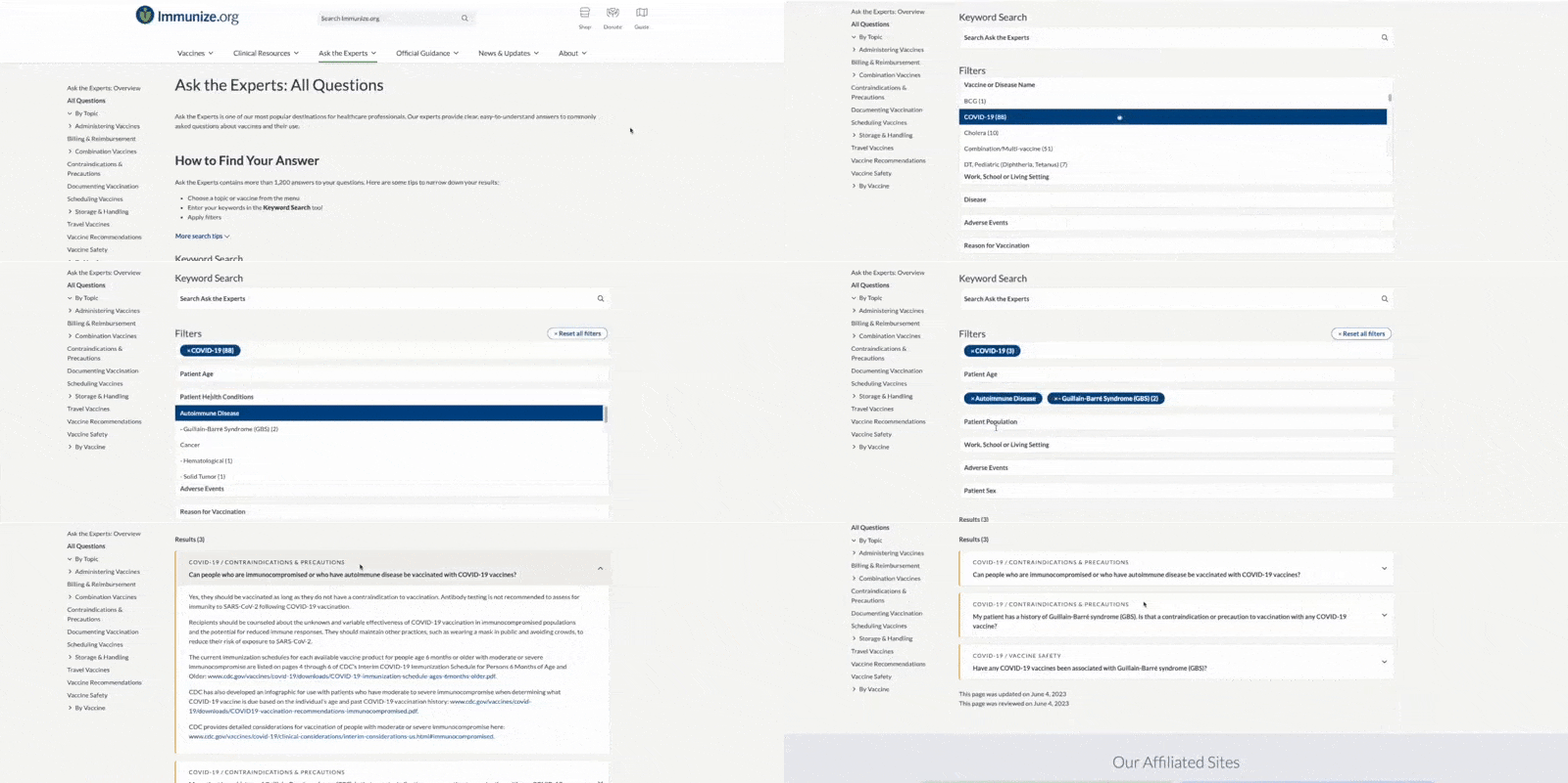
Immunize.org updated its Ask the Experts web section for COVID-19 vaccination. Answers now reflect current recommendations for the 2026–27 season from the American Academy of Pediatrics (AAP), American Academy of Family Physicians (AAFP), American College of Obstetricians and Gynecologists (ACOG), and Infectious Diseases Society of America (IDSA), as well as updated clinical considerations from CDC. There are nine new questions and answers, including:
- How Do AAP’s 2026–27 COVID-19 Vaccination Recommendations Differ from CDC’s Clinical Considerations?
- How Do ACOG’s 2026–27 COVID-19 Vaccination Recommendations Differ from CDC’s Clinical Considerations?
- How Do AAFP’s 2026–27 COVID-19 Vaccination Recommendations Differ from CDC’s Clinical Considerations?
- How Do IDSA’s 2026–27 COVID-19 Vaccination Recommendations Differ from CDC’s Clinical Considerations?
- Is It Okay to Follow a COVID-19 Vaccination Recommendation by a Medical Society or CDC, That Is Not Within the FDA-Approved Labeling?
- Are Spikevax and mNexspike Always Interchangeable?
- Should a Child Wait Until Later in the Winter to Receive the Updated COVID-19 Vaccine?
- Does a Healthy, Never-Vaccinated 10-Year-Old Need a Medical Risk Condition Before AAP Recommends COVID-19 Vaccination?
- A Child Received a Dose of COVID-19 Vaccine That Was Too Small. What Should We Do?
Immunize.org's Ask the Experts main page leads you to 30 distinct web sections on dozens of topics with more than 1,300 common or challenging questions and answers about vaccines and their administration. Immunize.org's team of experts includes Kelly L. Moore, MD, MPH (team lead); Carolyn B. Bridges, MD, FACP; Iyabode Beysolow, MD, MPH; and Jane R. Zucker, MD, MSc.
North Dakota State University's Center for Immunization Research and Education (CIRE) launched a 2026–2027 Respiratory Virus Season Social Media Toolkit. It offers ready-to-use social media messages about staying healthy during respiratory infection season—and protecting the people, places, and moments that matter. Resources include suggested captions to use alongside social media graphics. CIRE encourages adapting the introductory wording to match your organization’s voice, while keeping the health information accurate.


View all resources in CIRE's 2026–2027 Respiratory Virus Season Social Media Toolkit
One document puts every available translation of the injectable influenza vaccine VIS at your fingertips as you prepare for influenza vaccination clinics this fall. Be ready to offer influenza vaccine information in their preferred language to almost any client who walks in.
Titled QR Code Links to Vaccine Information Statement (VIS) Translations: Influenza (Flu) Vaccine (Inactivated or Recombinant), this 3-page PDF assembles QR codes for 44 injectable influenza VIS translations. Page one leads off with basic instructions, along with the QR code to the required English VIS and the most popular VIS translation, Spanish. Pages two and three provide the QR codes for each additional language option, along with a few additional VIS resources.
Each QR code is labeled with the language name in English and in the corresponding language. This allows vaccine recipients who do not read English to locate and scan the code for their preferred language with their own smartphone.


This resource does not go out of date. If a VIS is updated, the QR code will automatically link to the current version available online at Immunize.org. Download this resource today as you prepare for influenza vaccination clinics this fall.
Related Links
- Immunize.org: Vaccines A–Z: Influenza web page
- Immunize.org: Clinical Resources A–Z main page, where you can filter by topic, vaccine, language, or other criteria
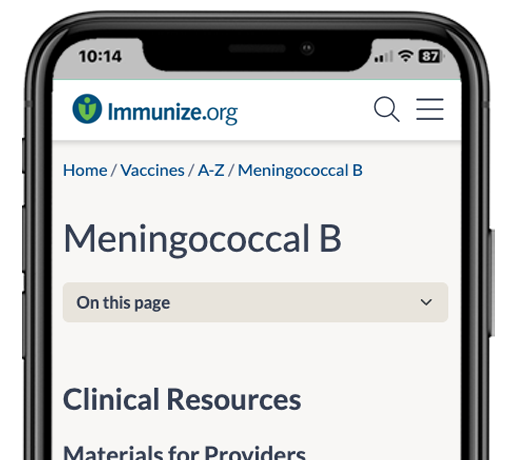
Explore the www.Give2MenACWY.org website to increase uptake for the MenACWY booster and other adolescent vaccinations
Immunize.org's www.Give2MenACWY.org website promotes the importance of adolescent vaccination, including the recommended MenACWY vaccine booster dose at age 16. Many teens are behind on vaccines, so vaccine outreach is more important than ever.
If you are looking for tools to explain meningococcal vaccine recommendations and assist in improving adolescent uptake of all recommended vaccines, view this site. Check out the many helpful tools from Immunize.org, CDC, and other organizations.

The website is divided into five easy-to-access sections:
- Vaccinate Teens: teen vaccination schedules and tips for improving vaccination rates
- Give 2 Doses: tools to help improve second dose MenACWY vaccination rates
- 16-Year-Old Visit: resources to help providers and patients remember the important vaccines recommended for 16-year-olds
- Tools for Providers: tools to explain MenACWY recommendations and improve uptake for all adolescent vaccines
- Resources: links to print materials, organizations involved in adolescent vaccination, personal stories about the importance of vaccination, and other resources of interest
The site also categorizes materials according to whether they are primarily of interest to providers, to adolescents, or to parents.
Visit Give2MenACWY.org and enjoy browsing (and deploying) its bountiful resources.
Related Links
- MenACWY: You're Not Done If You Give Just One: Give 2 Doses to Strengthen Protection
- Recommending MenACWY: What to Say and How to Say It
- Top 10 Ways to Improve Adolescent Immunization Rates
- Developing an Immunization Culture in Your Office
- Know Your Rates: Measuring Immunization Success in Your Practice
- Immunize.org: You're 16: We Recommend These Vaccines for You
- Dear Colleague Letter: 16-Year-Old Patients: Make Sure They Receive Their Annual Well Visit and Vaccinations, signed by six medical societies
- Immunize.org: Ask the Experts: Meningococcal ACWY
- CDC: ACIP Meningococcal Vaccine Recommendations
- CDC: Vaccination Coverage Among Adolescents Aged 13–17 Years—National Immunization Survey–Teen, United States, 2024
To learn simple tips and tricks for using our websites efficiently, please register for our next set of Website Office Hours on Wednesday, November 11, at 4:00 p.m. (ET) or Thursday, November 12, at 12:00 p.m. (ET). The same content will be discussed in both sessions.
We will open each 30-minute session with a short, live demonstration on navigating the popular VIS website section on Immunize.org. You can submit questions when you register or live on Zoom during the session.

Register today for Immunize.org Website Office Hours (content is the same for both):
The archive of previous Website Office Hours content is posted at Immunize.org’s "Webinars & Videos" page. Shorter, demonstration-only recordings of previous Website Office Hours are also available in our Website Training Videos series.
Mark your calendar for future Immunize.org Website Office Hours.
The Vaccine Education Center (VEC) at Children's Hospital of Philadelphia (CHOP) will present a 1-hour webinar titled The mRNA Influenza Vaccine: A New Vaccine for Older Adults beginning at 12:00 p.m. (ET) on December 9. Part of its Current Issues in Vaccines series, the webinar will feature Paul Offit, MD, director of the VEC.
Free continuing-education credits (CME, CEU, and CPE) will be available for both the live and archived events.
Register for the webinar.
For more upcoming events, visit our Calendar of Events.
About IZ Express
IZ Express Disclaimer
ISSN 2771-8085
Editorial Information
-
Editor-in-ChiefKelly L. Moore, MD, MPH
-
Managing EditorJohn D. Grabenstein, RPh, PhD
-
Associate EditorSharon G. Humiston, MD, MPH
-
Writer/Publication CoordinatorTaryn Chapman, MS
Courtnay Londo, MA -
Style and Copy EditorMarian Deegan, JD
-
Web Edition ManagersArkady Shakhnovich
Jermaine Royes -
Technical ReviewerKayla Ohlde