

Immunization Action Coalition

Home page
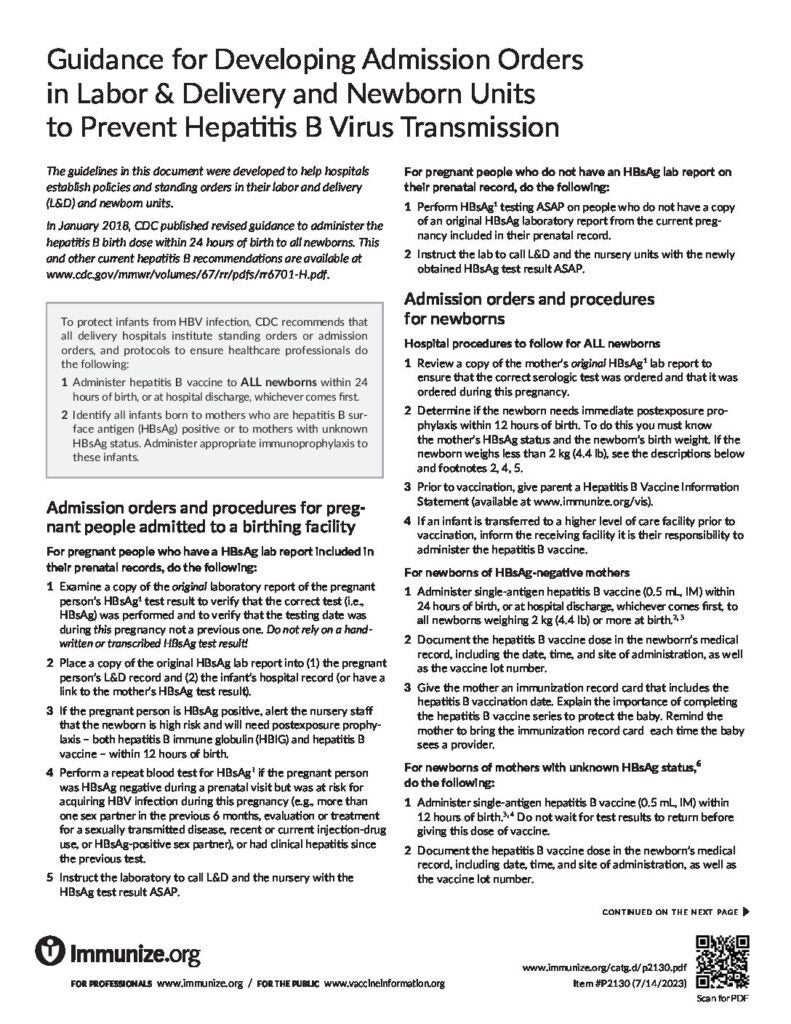
Hospitals & Doctors Sued for Failing to Protect Newborns
from Hepatitis B Virus Transmission
 For a formatted version (PDF) of this web page, suitable for copying, click here.

The PDF version is identical to the original printed document and is suitable for making copies. Adobe Acrobat Reader
is needed  to view it. The web version  below contains the full text of this document but without the original formatting.

  
Case #1
In 1989 on the West Coast, a woman was identified as being chronically infected with hepatitis B during her prenatal care. However, this information was not transmitted to the newborn nursery at the time of delivery. Her baby received neither hepatitis B immune globulin (HBIG) nor hepatitis B vaccine and the infant subsequently became chronically infected. The mother sued the hospital, the obstetrician, and the pediatrician. A substantial settlement was awarded.

Case #2
In a large Midwestern city in approximately 1988, a woman was screened in pregnancy and was found to be hepatitis B surface antigen (HBsAg) positive. Her baby was born and appropriately immunized at birth with HBIG and hepatitis B vaccine. The baby returned for well child care with a provider who was at the hospital-based clinic. The parents asked if the baby needed a second dose of hepatitis B vaccine. The provider reviewed the birth record and told the parents that the vaccine was not necessary and did not give the follow-up dose. The provider did not understand the indications for hepatitis B vaccine. At 12 months of age, the child was found to have chronic persistent hepatitis B by the hospital's follow-up clinic that tracks the infants born to HBsAg positive mothers. The hospital was sued and the case was settled out of court.
Cases #3 and #4
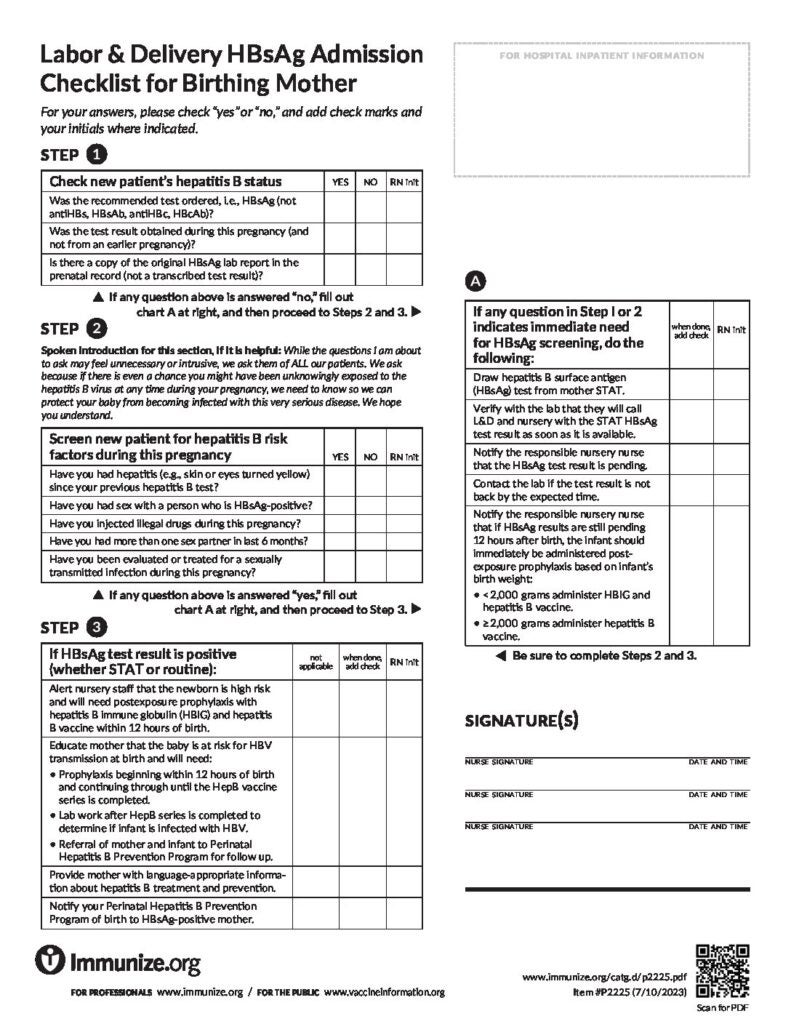
These cases occurred at a large teaching hospital affiliated with a medical school in a state where a law exists mandating prenatal hepatitis B screening. In this hospital, mothers were not routinely screened at delivery, but the neonatologist tested every infant for HBsAg as part of a panel of tests that were routinely done on cord blood. If this test was negative, no hepatitis B vaccination was given. If the test was positive, sometimes vaccine and HBIG were given and sometimes they were not ("too late—baby already infected"). Both of the infants at the centers of these lawsuits were born in 1991 when this policy was in effect. In one case, the mother had been tested during her pregnancy but the test results were not communicated to her or to the hospital. The infant's cord blood test was negative. In a subsequent pregnancy she was discovered to be HBsAg positive and was referred to the state's perinatal program. Her other children were tested as a part of this program and the one child was discovered to be chronically infected. In the other case, the mother had not been tested during the pregnancy. The cord blood of this infant was positive for HBsAg, but the report was received after the discharge of the infant and the report was filed without action. In both cases, the infants were not treated for perinatal exposure because the hospital was relying on cord blood testing to determine the need for hepatitis B prophylaxis. The hospital policy has since been changed and all mothers are screened on admission to labor and delivery. Lawsuits are pending in both cases [1994]. (IAC has no further information about these cases.)
Case #5
On December 13, 1999, a previously healthy 3-month-old infant of Southeast Asian descent was brought to a hospital emergency department and was admitted following a 5-day history of fever, diarrhea, and jaundice. Upon admission to the hospital, hepatitis B serology was obtained along with liver function tests and liver enzymes. Laboratory results revealed that the infant was HBsAg positive and IgM core antibody (IgM anti-HBc) positive. The infant's mother was tested at the same time and was found to be HBsAg positive and anti-HBc positive. A diagnosis of hepatic failure due to hepatitis B virus infection was made; tragically, the infant died on December 17 of fulminant hepatitis B. Investigation revealed that the infant's mother had tested positive for HBsAg during her pregnancy but that the test result was communicated incorrectly as "hepatitis negative" to the hospital where the baby was born. Neither the laboratory nor the prenatal care provider reported the HBsAg-positive test results to the local health department as required by state law. The infant received no hepatitis B vaccine and no HBIG at the time of birth. There has been no litigation to date [2000], but the physician lost his license to practice medicine. (IAC has no further information about this case.)

Item #P2061 (9/06)
www.immunize.org/catg.d/p2061.pdf

Home page

Immunization Action Coalition1573 Selby AvenueSt. Paul MN 55104
E-mail: admin@immunize.org Web: http://www.immunize.org/
Tel: (651) 647-9009Fax: (651) 647-9131