
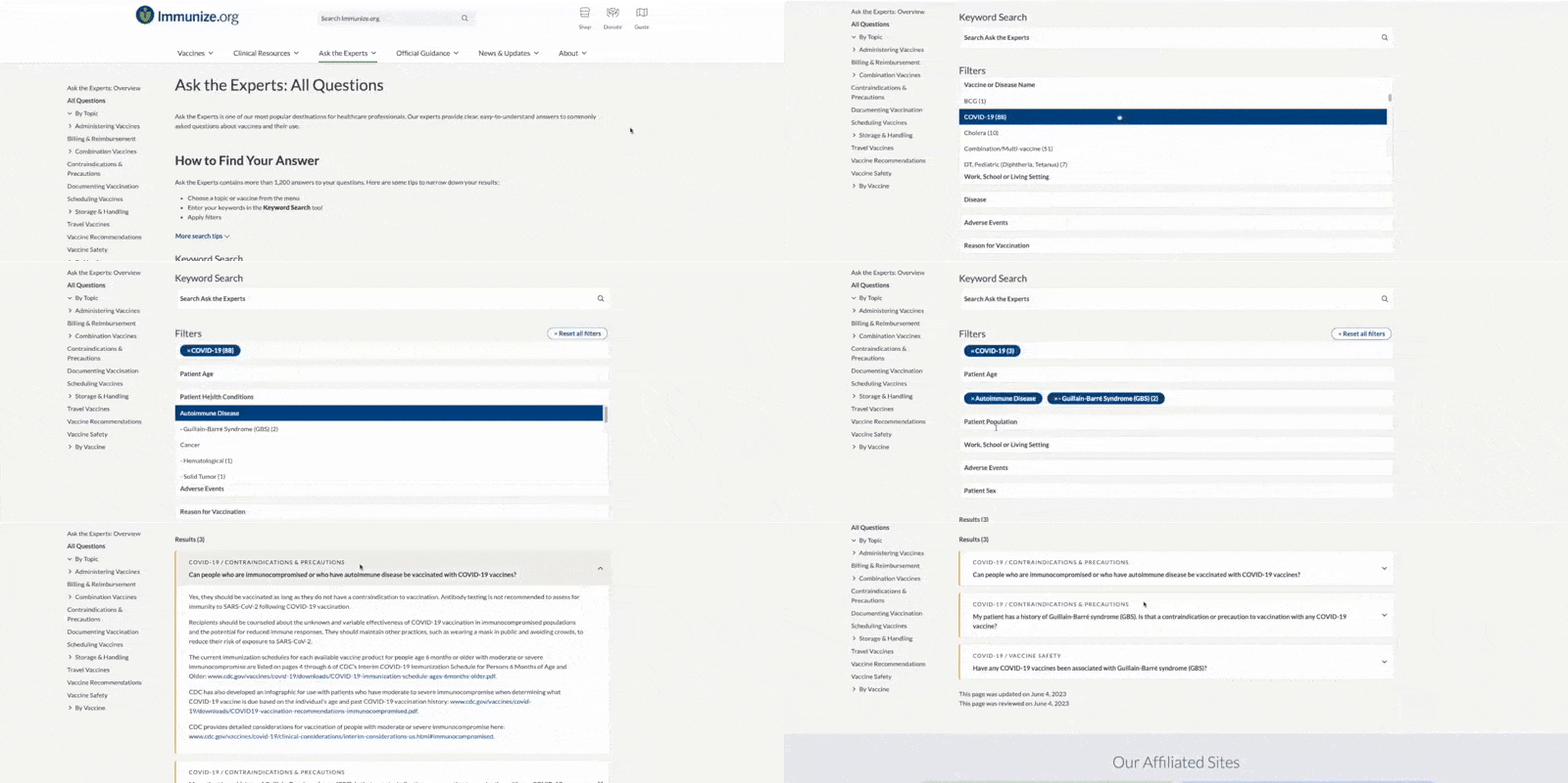


- Immunize.org updates Ask the Experts web section on COVID-19 to incorporate 2026 guidance from medical societies and CDC
- KFF opinion poll on health information and trust finds both confidence and misunderstanding
- Respiratory diseases: Influenza activity continues to climb nationwide; don’t wait—vaccinate!
- Measles 2026: Johns Hopkins University reports 4,730 confirmed cases; Pennsylvania releases guidance on congenital measles
- "What Is a Latex Allergy and When Is It a Problem for Vaccination?” New in the Ask the Experts Video Series on YouTube.
- HepB birth dose policies protect babies. Immunize.org’s Hepatitis B Birth Dose Honor Roll recognizes 598 institutions, including one new honoree.
- Vaccines in the news
- Spotlight on the LetsGetRealAboutVaccines.org website: "Separate Fact from Fiction"
- Recap: Immunize.org reviews and updates Ask the Experts web section on influenza
- Recap: Immunize.org updates two resources on diluents and route of administration
- Recap: Immunize.org updates "When Do Children and Teens Need Vaccinations?" resource
- Recap: Immunize.org updates two MenACWY resources for clinicians with updated MenQuadfi age indication
- Immunize Kansas Coalition shares frontline vaccinator training bundle for childhood immunizations; CE credit offered
- Lantern launches FACT, a free text-message series that answers parents’ questions about childhood vaccines
- Vaccine Resource Hub offers collection of Halloween-themed graphics and videos to share on your social media networks
- Immunize.org's elegant "Vaccination Saves Lives" blue enamel pins make wonderful holiday gifts or workplace recognitions
- “Projected Effect of 2026 Federal Changes to the Childhood Immunization Schedule on Chronic Hepatitis B Virus Infections in the United States” published in Annals of Internal Medicine
- "Measles, Mumps, and Rubella Diseases and MMR Vaccine for the Christian Healthcare Professional," published in Ethics & Medicine
- Virtual: National Hispanic Medical Association and the National Medical Association host webinar titled “Advancing Maternal Immunization Equity in Black and Latino Communities” on October 29 at 7:00 p.m. (ET)
- Register for Immunize.org Website Office Hours. Join a 30-minute discussion about the VIS web section on November 11 at 4:00 p.m. (ET) or November 12 at 12:00 p.m. (ET). Recorded sessions archived.
Immunize.org updated its Ask the Experts web section for COVID-19 vaccination. Answers now reflect current recommendations for the 2026–27 season from the American Academy of Pediatrics (AAP), American Academy of Family Physicians (AAFP), American College of Obstetricians and Gynecologists (ACOG), and Infectious Diseases Society of America (IDSA), as well as updated clinical considerations from CDC. There are nine new questions and answers, including:
- How do AAP’s 2026–27 COVID-19 vaccination recommendations differ from CDC’s clinical considerations?
- How do ACOG’s 2026–27 COVID-19 vaccination recommendations differ from CDC’s clinical considerations?
- How do AAFP’s 2026–27 COVID-19 vaccination recommendations differ from CDC’s clinical considerations?
- How do IDSA’s 2026–27 COVID-19 vaccination recommendations differ from CDC’s clinical considerations?
- Is it okay to follow a COVID-19 vaccination recommendation by a medical society or CDC, that is not within the FDA-approved labeling?
- Are Spikevax and mNexspike always interchangeable?
- Should a child wait until later in the winter to receive the updated COVID-19 vaccine?
- Does a healthy, never-vaccinated 10-year-old need a medical risk condition before AAP recommends COVID-19 vaccination?
- A child received a dose of COVID-19 vaccine that was too small. What should we do?

Immunize.org's Ask the Experts main page leads you to 30 distinct web sections on dozens of topics with more than 1,300 common or challenging questions and answers about vaccines and their administration. Immunize.org's team of experts includes Kelly L. Moore, MD, MPH (team lead); Carolyn B. Bridges, MD, FACP; Iyabode Beysolow, MD, MPH; and Jane R. Zucker, MD, MSc.
Related Links
- Immunize.org: Ask the Experts main page to access more than 1,300 questions and answers in narrative or video format
- Immunize.org: View All Video Questions, 93 quick videos of individual questions and answers found in Ask the Experts; use filters to narrow choices
- Immunize.org: Orientation Video Series: Introducing Ask the Experts (3:36), Dr. Kelly Moore introduces the Ask the Experts section; also available for mobile devices
- Immunize.org: Website Office Hours: Ask the Experts (29:31) provides in-depth guidance for navigating the Ask the Experts section of the website
On October 20, KFF released its latest Tracking Poll on Health Information and Trust: Fall 2026 Update on Vaccine Views. The survey was conducted September 16–21, after the August 10 release of the Presidential Executive Order calling for changes to the U.S. childhood vaccine schedule and the Senate hearing with Anthony Fauci, MD. Understanding the shifts in these beliefs may help healthcare professionals anticipate and more effectively address parental concerns. The findings include:
- Confidence in most childhood vaccines remains high, but views on the safety of COVID-19 vaccines for children and pregnant patients differed by political affiliation. A significant share of the public expresses uncertainty or holds misconceptions about recent vaccine news.
- About half of parents mistakenly believed that children are healthier when vaccines are spaced out so they do not receive multiple shots in a single visit. No evidence supports this claim. Parents identifying as Republican were more likely to hold this view, while 7 in 10 parents identifying as Democratic said there is no evidence for it.
- Confidence in the safety of long-standing childhood vaccines such as polio and MMR remained high across party lines. Majorities also expressed confidence in hepatitis B and influenza vaccines for children, though Republicans were less confident than Democrats.
- Views of COVID-19 vaccine safety were politically polarized. Among Democrats, 77% were confident the vaccines are safe for children, compared with 21% of Republicans. For vaccination during pregnancy, the figures are 62% and 17%. Most adults, including 8 in 10 women of reproductive age, were uncertain about the false claim that COVID-19 vaccination during pregnancy increases miscarriage risk.
- Many supporters of the Make America Healthy Again movement among the respondents were confident in childhood vaccines, including about three-quarters for MMR (76%) and polio (76%). However, only about 3 in 10 (28%) were confident in the safety of COVID-19 vaccines for children.

Related Links
- KFF: Tracking Poll on Health Information and Trust: Fall 2026 Update on Vaccine Views (10/20/26)
- Immunize.org: Ask the Experts: Alternative Schedules (YouTube)
- Immunize.org: Ask the Experts: Are COVID-19 Vaccines Safe During Pregnancy?
In the United States, for the week reported on October 23, influenza activity is increasing in many parts of the country but remains low overall nationally. CDC notes that activity is higher than is typical for this early in the season.
Vaccination takes 2 weeks to induce immunity, so vaccinate now. Influenza vaccination offers an opportunity to receive or schedule other vaccinations that may be needed, such as COVID-19, pneumococcal, and RSV vaccines.
The map below shows the general levels of influenza-like illness activity across the states as of October 17.

COVID-19 vaccination is recommended annually for all adults, children age 6 months through 23 months, and older children who are immunocompromised, have other high-risk conditions, live with people with high-risk conditions, or who just want protection.
RSV vaccination is recommended for all adults age 75 years and older, as well as adults at high risk of severe RSV disease age 50 years and older. RSV vaccination between 32 and 36 6/7 weeks’ gestation is an option for RSV protection of newborns. If RSV vaccine is not administered during pregnancy, infants through age 8 months, 0 days, may receive RSV preventive antibodies (nirsevimab or clesrovimab). Remember that adults, including pregnant patients, who previously received RSV vaccine are not recommended to receive another dose.
During the week ending October 23, compared to the previous week, the percentage of visits for respiratory illness increased in the 0–4 years and 5–24 years age groups. It remained stable in the older age groups, as shown in the graph below.

Respiratory Illness Data Channel
CDC's Respiratory Illness Data Channel web page shows a snapshot of the amount of acute respiratory illness (ARI) causing people to seek health care in the United States. Local data are available by state or territory and by county. CDC reports:
- COVID-19: activity remains elevated in some regions but is declining nationally
- RSV: activity remains very low in most areas of the country
Related Links
- CDC: Weekly National Flu Vaccination Dashboard main page
- CDC: FluView main page
- CDC: RESP-NET main page
- Immunize.org: Clinical Resources: Seasonal Vaccines (Influenza, RSV, COVID-19) main page
- VaccineInformation.org: Where to Get Vaccinated web page
As of October 23, 2026, the U.S. Measles Tracker, operated by Johns Hopkins University (JHU), reported 4,730 measles cases for 2026. Through October 23, 2026, CDC reported 4,588 confirmed cases.
Congenital measles in Pennsylvania
As the Pennsylvania measles outbreak grows, with most cases reported in the state occurring among unvaccinated adults, reports of measles illness during pregnancy have also risen. According to CIDRAP, 66 pregnant patients in Pennsylvania were infected with measles this year, and at least six babies were born with congenital measles. The Pennsylvania Department of Health issued a health advisory on October 19 providing detailed guidance on the condition that has not been seen in the state in decades. In areas with significant ongoing outbreaks or in preparation for international travel, state or local public health officials may recommend that a baby receive an early dose of MMR at age 6 through 11 months, before their first routine dose at age 12–15 months. For more on prevention, diagnosis, and management of congenital measles, see AAP’s Congenital Measles: Frequently Asked Questions in Red Book Online and Immunize.org's measles main page.

United States measles elimination status will be reviewed in November
The Measles and Rubella Elimination Regional Monitoring and Re-Verification Commission of the Pan American Health Organization (PAHO) is scheduled to meet November 10–13 in Washington, DC, to review the measles elimination status of countries in the Americas, including the United States and Mexico. An announcement about the determination is expected by November 16. A country may lose its elimination status after confirmation of uninterrupted measles transmission for 12 months or more. Canada lost its elimination status in September 2025. Although the determination is largely symbolic, it is illustrative of how suboptimal measles vaccination rates allow the measles virus to re-establish ongoing local circulation.
Related Links
- CDC: Measles Cases and Outbreaks main page
- Immunize.org: Vaccines A–Z: Measles main page
- LetsGetRealAboutVaccines.org: Measles web page
- CDC: Be Ready for Measles Toolkit
- AAP: Immunization Facts for Families (MMR) (PDF)
"What Is a Latex Allergy and When Is It a Problem for Vaccination?” New in the Ask the Experts Video Series on YouTube.
This week, our featured episode from the Ask the Experts Video Series is titled What Is a Latex Allergy and When Is It a Problem for Vaccination? The video briefly explains that latex can be found in some vaccine packaging, such as syringe plungers, vial stoppers, and prefilled syringe tip caps. People with a history of anaphylaxis to latex should generally avoid vaccines in latex-containing packaging unless the benefits outweigh the risks. Refer to vaccine package inserts to confirm whether latex is present.
The 1-minute video is available on our YouTube channel, along with our full collection of quick video answers to popular Ask the Experts questions.

Like, follow, and share Immunize.org’s social media accounts and encourage colleagues and others interested in vaccination to do likewise.
- Facebook at ImmunizeOrg
- Instagram at ImmunizeOrg
- LinkedIn at ImmunizeOrg
- YouTube at ImmunizeOrg
- Immunize.org: Ask the Experts: all contraindications and precautions-related video questions (5 videos)
HepB vaccination during infancy is extremely effective, protecting about 98% of healthy, term infants. Infection with hepatitis B virus (HBV) during the first year of life results in chronic, lifelong infection for about 9 in 10 babies. One in four infants who go on to develop chronic hepatitis B will die prematurely from consequences of infection, including liver failure or cancer. Vaccination and use of hepatitis B immune globulin (HBIG) for infants born to both HBV test-positive mothers and mothers of unknown status reduces the risk of HBV transmission by 94%. Vaccination alone, given on the day of birth, reduces the risk by 75%.
To ensure every child is protected, the HepB birth dose was first recommended for all U.S.-born infants in 2005. In 2016, ACIP specified that the vaccine should be given within the first 24 hours of life to better protect any newborn with an unrecognized HBV exposure. In 2013, Immunize.org started recognizing birthing institutions that established policies and practices so that at least 90% of their newborns received HepB before going home. These policies and practices represent a crucial safety net to protect newborns from the lifelong consequences of early HBV infection.
Immunize.org is pleased to welcome one new institution into its Hepatitis B Birth Dose Honor Roll, which now recognizes 598 honorees. The new birthing institution appears below with its reported HepB birth dose vaccination rate in parentheses.
- Thomas Jefferson University Hospital, Philadelphia, PA (90%)
Please join us in recognizing these honorees with sustained excellence that qualify for an additional year:
- LBJ Tropical Medical Center, Pago Pago, AS (99%) (2 years)
- Lehigh Valley Hospital–Hazelton, Hazelton, PA (91%) (2 years)
- Lehigh Valley Hospital–Schuylkill, Pottsville, PA (94%) (4 years)
The Honor Roll includes birthing institutions from 50 states, the District of Columbia, U.S. territories, and U.S. military hospitals overseas.

The Honor Roll is a key part of Immunize.org’s initiative urging the nation’s hospitals to Give Birth to the End of Hep B. Hospitals and birthing centers are recognized for attaining high HepB vaccination rates at birth and meeting additional criteria. The How to Apply web page provides information on the criteria for inclusion in the Hepatitis B Birth Dose Honor Role and the application form.
Please visit the Hepatitis B Birth Dose Honor Roll web page that lists these institutions and celebrates their vigorous efforts to protect infants from perinatal hepatitis B transmission.
Related Immunize.org Resources
- Give Birth to the End of Hep B main page
- Hepatitis B Birth Dose Honor Roll web page
These recent articles convey the potential risks of vaccine-preventable diseases and the importance of vaccination.
- The Guardian: Controversial US-Backed Vaccine Trial in African Newborns Halted (10/21/26)
- STAT: A Counterintuitive Way to Build Trust in Measles Vaccines and Public Health (10/21/26)
- MedPage Today: What Makes Vaccine Safety Research Credible? (10/20/26)
- CNN: For More Parents, ‘Vaccine Refusal’ Is Becoming Vaccine Delay, but It’s No Less Dangerous (10/15/26)

LetsGetRealAboutVaccines.org is a parent-friendly platform that delivers factual vaccine guidance. It equips families and providers with tools to advocate for childhood immunization confidently.
This week, we spotlight the website's Separate Fact from Fiction section. Found at the second menu tab, this section identifies common methods used to create misinformation about vaccines.

The main page focuses on distinguishing vaccine fact from fiction. Five supporting pages are available on this page and the menu:
- Doing Your Own Research: tips to get the most out of independent learning and how it differs from scientific research
- Credibility Checklist: ten ways to help decide if information is trustworthy
- Correlation vs. Causation: explanation about events occurring in a similar time frame, but the results are not caused by the event
- Five Reasons to Vaccinate Your Child: science-based facts support that vaccination is one of the most important things you can do to protect your child’s health
- Understanding Risk: how bad, how likely, and what would happen without any action are the parts of the equation needed to assess risk in context
Please share these links with anyone seeking credible, unbiased information about childhood vaccines. View our recent webinar, Website Office Hours: Websites for the Public: VaccineInformation.org and LetsGetRealAboutVaccines.org, to take an informational tour of both affiliated websites.
Immunize.org updated its Ask the Experts web section for influenza vaccination. Answers now reflect current recommendations for the 2026–27 season from the American Academy of Pediatrics (AAP), American Academy of Family Physicians (AAFP), American College of Obstetricians and Gynecologists (ACOG), and Infectious Diseases Society of America (IDSA), as well as updated clinical considerations from CDC.
Immunize.org recently updated two clinical resources. Because the last available doses of the discontinued Dengvaxia dengue vaccine expired, dengue vaccine references were removed. Edits include:
- How to Administer Intramuscular and Subcutaneous Vaccine Injections: Administration by the Intramuscular (IM) Route: Dengvaxia removed, additional details included in the table for needle-length selection in adults, and detail added about vaccination route options for mpox vaccine
- Vaccines with Diluents: How to Use Them: Dengvaxia removed
Immunize.org updated When Do Children and Teens Need Vaccinations?, a simple table for families about the vaccination schedule. Revisions include removing dengue vaccine (no longer available in the United States) and modifying footnotes on COVID-19, RSV, and HPV vaccines. COVID-19 vaccine is shown as routinely recommended for all children age 6 through 23 months, beginning with a 2-dose initial series.
Recap: Immunize.org updates two MenACWY resources for clinicians with updated MenQuadfi age indication
Immunize.org updated two MenACWY resources. They now reflect the American Academy of Pediatrics (AAP) September 2026 revised recommendation for use of MenQuadfi (Sanofi) as an option when MenACWY vaccination is indicated for an infant at high risk of meningococcal disease, beginning as early as age 6 weeks. This revised recommendation was made after the 2025 change in the minimum FDA-licensed age. The lyophilized formulation of Menveo (GSK) is FDA-approved beginning at age 2 months. The updated resources include:
- Meningococcal ACWY Vaccine Recommendations by Age and Risk Factor
- Standing Orders for Administering Meningococcal ACWY Vaccine to Children and Teens
Featured Resources
Immunize Kansas Coalition (IKC) recently released a bundle of resources for frontline vaccinators. Featured materials include new education modules for healthcare professionals and accompanying handouts. The modules offer continuing education credit for physicians, physician associates, nurses, and pharmacists at no charge.
- Giving Vaccines to Children: Getting it Right: Learners are presented with scenarios that call upon knowledge of vaccine administration and vaccine communication. This module harnesses the detail content at Immunize.org's web section Getting Started: For the New Vaccinator.
- Protecting Patients with Vaccines: Tailored to nurses and medical assistants, learners review practical strategies for communicating with patients, addressing common concerns, and reinforcing strong vaccine recommendations as part of everyday patient care.
- Reducing Vaccination Pain and Anxiety in Children: Designed for teams who vaccinate children, this module emphasizes the importance of reducing vaccination-related pain and anxiety, assessing patient needs, and using practical, evidence-based strategies that can improve the vaccination experience for children, caregivers, and clinical teams. The module features a supporting handout that providers can share with parents or caregivers. IKC also offers a webinar recording on this same topic and offers continuing education credit at no charge.

These educational modules, created in collaboration with Immunize.org’s Sharon Humiston, MD, MPH, are available on IKC’s Provider Education and Communications Resource Hub, a treasure trove of resources for healthcare professionals.
Lantern launches FACT, a free text-message series that answers parents’ questions about childhood vaccines
Lantern, a national nonprofit that provides families with information for raising kids, launched FACT, a free text message series for parents of children ages 0–12 who have questions about vaccines.
FACT starts from the premise that most parents who pause before vaccinating aren’t anti-vaccine. They’re trying to make a thoughtful decision for someone they love. Parents who sign up receive one short, simple text message per week for 2 months, each answering one of the questions parents ask most often:
- How vaccines work
- What vaccines contain
- How vaccine safety is tested and monitored
- How to weigh the risks of the diseases vaccines prevent
The messages offer "no jargon, no lectures, no pressure—just clear information.”
To help spread the word, Lantern offers a partner toolkit with newsletter text, suggested social media posts, and printable postcards, flyers, banners, and social media images in English, Spanish, and Arabic. Healthcare providers can share the program with families with vaccine questions.

To sign up, text FACT to 274 448 or visit mylantern.org/fact.
Vaccine Resource Hub offers collection of Halloween-themed graphics and videos to share on your social media networks
Halloween is around the corner. Now is a good time to plan some seasonal vaccine messaging. The Vaccine Resource Hub, a project of Public Good Projects, collects ready-to-use Halloween-themed social media graphics and videos from health departments and other organizations. Several encourage families to get vaccinated against flu before trick-or-treating.

"Boo to the Flu,” originally launched by Families Fighting Flu in 2004, is a favorite theme every October. Many health departments, hospitals, schools, and coalitions create their own social media graphics and videos. Borrow a graphic or design your own. Be sure to use #BooToTheFlu in your social media postings.
Browse all the Halloween-related resources on the Vaccine Resource Hub.
Immunize.org's elegant "Vaccination Saves Lives" blue enamel pins make wonderful holiday gifts or workplace recognitions
Our 2025 Vaccination Saves Lives pins are meaningful gifts for people who understand that lives are not saved by vaccines on a shelf, but by the act of vaccination. The pin makes a refined statement in rich blue enamel with gold lettering and edges, measuring 1.65" x 0.75".


Select the design that best suits how you plan to use your pin:
- Double stick-through posts: Two posts slide through fabric and are held securely by either rubber or locking-metal backings. Both types of backing are provided in the package.
- New! Magnetic clasp: Hold the pin firmly in place without piercing clothing.


Be first in your office to wear these elegant new pins on clothing, white coats, backpacks, or tote bags to remind everyone you meet of the value of vaccination.
Click here for Vaccination Saves Lives pin pricing and ordering information.
In its October 20 issue, Annals of Internal Medicine published Projected Effect of 2026 Federal Changes to the Childhood Immunization Schedule on Chronic Hepatitis B Virus Infections in the United States. This modeling study projects that recent federal changes to HepB recommendations for infants could substantially increase childhood infections.
Researchers at Mass General Brigham modeled one year of births (3.6 million infants) in the United States through age 20. They found that delaying the first infant dose to age 2 months for infants of mothers who test negative would increase chronic hepatitis B infections by about 19%. A shared clinical decision-making approach, modeled as only half of these infants being vaccinated, would increase infections by about 83%. Under shared decision-making, between 50% and 70% of children entering adulthood would be unprotected against hepatitis B.
Both the American Academy of Pediatrics and the American Academy of Family Physicians continue to recommend that all newborns receive the hepatitis B vaccine within 24 hours of birth.
Related Links
- Medpage Today: Study Warns of More Chronic Hepatitis B in the Years Ahead (10/19/26)
- Mass General Brigham: Changes to Hepatitis B Immunization Schedule Would Increase Infections, Model Predicts (10/19/26)
In its December 31, 2025, issue, Ethics & Medicine published Measles, Mumps, and Rubella Diseases and MMR Vaccine for the Christian Healthcare Professional, by Richard K. Zimmerman, MD, MPH. Zimmerman, a University of Pittsburgh family medicine professor, writes for Christian healthcare professionals. He makes both a scientific and a faith-based case for MMR vaccine, against the backdrop of the 2026 United States measles outbreak. Recent measles outbreaks have been concentrated in some Christian faith-based communities. It is valuable for healthcare and public health professionals to learn to connect with communities with doubts about vaccines in culturally and religiously relevant and respectful terms.
Zimmerman makes the case that Christians may trust sound science. Drawing on theologians such as John Calvin, he describes scientific truth as part of God’s revelation and a gift available to everyone. He acknowledges problems in research and calls for humility—not going beyond one's own expertise.
Zimmerman discusses common reasons for vaccine hesitancy in some Christian communities, including remote fetal origins of cell lines and the contrast between God’s will and human responsibility.
Zimmerman concludes that vaccination is both biblical and medically sound. He notes biblical teachings to care for creation, prevent harm, act justly, and love one’s neighbor, especially people who cannot be vaccinated themselves. He urges healthcare professionals of Christian faith to speak up, staying within their expertise, and to share this perspective with faith communities.
A controversial study that would have withheld the HepB birth dose from half of the 14,000 newborns it planned to enroll in the West African nation of Guinea-Bissau will not go forward, according to the country’s prime minister. The study was to be partially funded by a $1.6 million grant from CDC.
CDC awarded the grant in December 2025 without the usual open-application process. In the proposed study, half of the west African country’s newborns would have received a birth dose, and the other half would have received their first dose at age 6 weeks, which is the country’s current practice, although the country plans adoption of a birth dose schedule by 2028. The study was not designed to measure protection against hepatitis B. Instead, it was intended to evaluate possible nonspecific effects of the birth dose, such as early illness, eczema, and neurodevelopmental outcomes for which no evidence currently exists.
Nearly 1 in 5 adults in Guinea-Bissau lives with chronic hepatitis B. Up to 90% of infants infected at birth develop chronic infection, and as many as 1 in 4 of them die prematurely from liver disease. In February, WHO Director-General Tedros Adhanom Ghebreyesus, PhD, called the study unethical. WHO said withholding the birth dose would expose newborns to “serious and potentially irreversible harm.” Africa CDC, members of the U.S. Congress, and many vaccine experts also raised ethical and scientific concerns.
In mid-October, Guinea-Bissau’s Council of Ministers reaffirmed its decision not to approve the trial. The study’s lead investigator, Frederik Schaltz-Buchholzer, MD, PhD, announced that the project would not proceed in Guinea-Bissau because it lacked government approval.
In the United States, the American Academy of Pediatrics and the American Academy of Family Physicians continue to recommend that all medically stable newborns receive HepB within 24 hours of birth.

Related Links
- WHO: Statement on the Planned Hepatitis B Birth Dose Vaccine Trial in Guinea-Bissau (2/13/26)
- Hepatitis B Foundation: The Hepatitis B Foundation and The African Hepatitis B Advocacy Coalition Denounce the Unethical HepB Birth Dose Study in Guinea-Bissau (10/14/26)
-
Immunize.org: Vaccines A–Z: Hepatitis B main page
The National Hispanic Medical Association (NHMA) and the National Medical Association (NMA) will host a webinar titled Advancing Maternal Immunization Equity in Black and Latino Communities at 7:00 p.m. (ET) on October 29. Speakers Oliver Brooks, MD, FAAP, former president, NMA; Sarah Ramírez, MD, FAAFP, Department of Family and Community Medicine, Penn State College of Medicine; and Diana Torres-Burgos, MD, MPH, senior advisor, NHMA; will join moderator Yolanda Lawson, MD, former president, NMA, to discuss maternal health and immunization disparities.
Speakers will share how to start meaningful vaccine conversations during prenatal visits, build trust with patients with questions or concerns, and reach families through culturally and linguistically responsive outreach. Learn practical, evidence-based strategies to increase maternal immunization, improve patient outreach, support informed vaccine decision-making, and expand access to preventive care.
Register for Immunize.org Website Office Hours. Join a 30-minute discussion about the VIS web section on November 11 at 4:00 p.m. (ET) or November 12 at 12:00 p.m. (ET). Recorded sessions archived.
To learn simple tips and tricks for using our websites efficiently, please register for our next set of Website Office Hours on Wednesday, November 11, at 4:00 p.m. (ET) or Thursday, November 12, at 12:00 p.m. (ET). The same content will be discussed in both sessions.
We will open each 30-minute session with a short, live demonstration on navigating the popular VIS website section on Immunize.org. You can submit questions when you register or live on Zoom during the session.

Register today for Immunize.org Website Office Hours (content is the same for both):
The archive of previous Website Office Hours content is posted at Immunize.org’s "Webinars & Videos" page. Shorter, demonstration-only recordings of previous Website Office Hours are also available in our Website Training Videos series.
Mark your calendar for future Immunize.org Website Office Hours.
For more upcoming events, visit our Calendar of Events.
About IZ Express
IZ Express Disclaimer
ISSN 2771-8085
Editorial Information
-
Editor-in-ChiefKelly L. Moore, MD, MPH
-
Managing EditorJohn D. Grabenstein, RPh, PhD
-
Associate EditorSharon G. Humiston, MD, MPH
-
Writer/Publication CoordinatorTaryn Chapman, MS
Courtnay Londo, MA -
Style and Copy EditorMarian Deegan, JD
-
Web Edition ManagersArkady Shakhnovich
Jermaine Royes -
Technical ReviewerKayla Ohlde