


- Immunize.org posts 2026–27 COVID-19 vaccine standing orders templates and updates “Checklist of Current Versions of U.S. COVID-19 Vaccination Guidance and Clinic Support Tools”
- Montana reports unvaccinated child’s death from complications of Haemophilus influenzae type b (Hib) infection
- Respiratory diseases: Influenza is rising early in the United States and abroad. Vaccinate now to allow time for immunity to develop.
- Measles 2026: Johns Hopkins University reports 4,267 confirmed cases; Pennsylvania becomes the first state in 35 years to surpass 1,000 cases
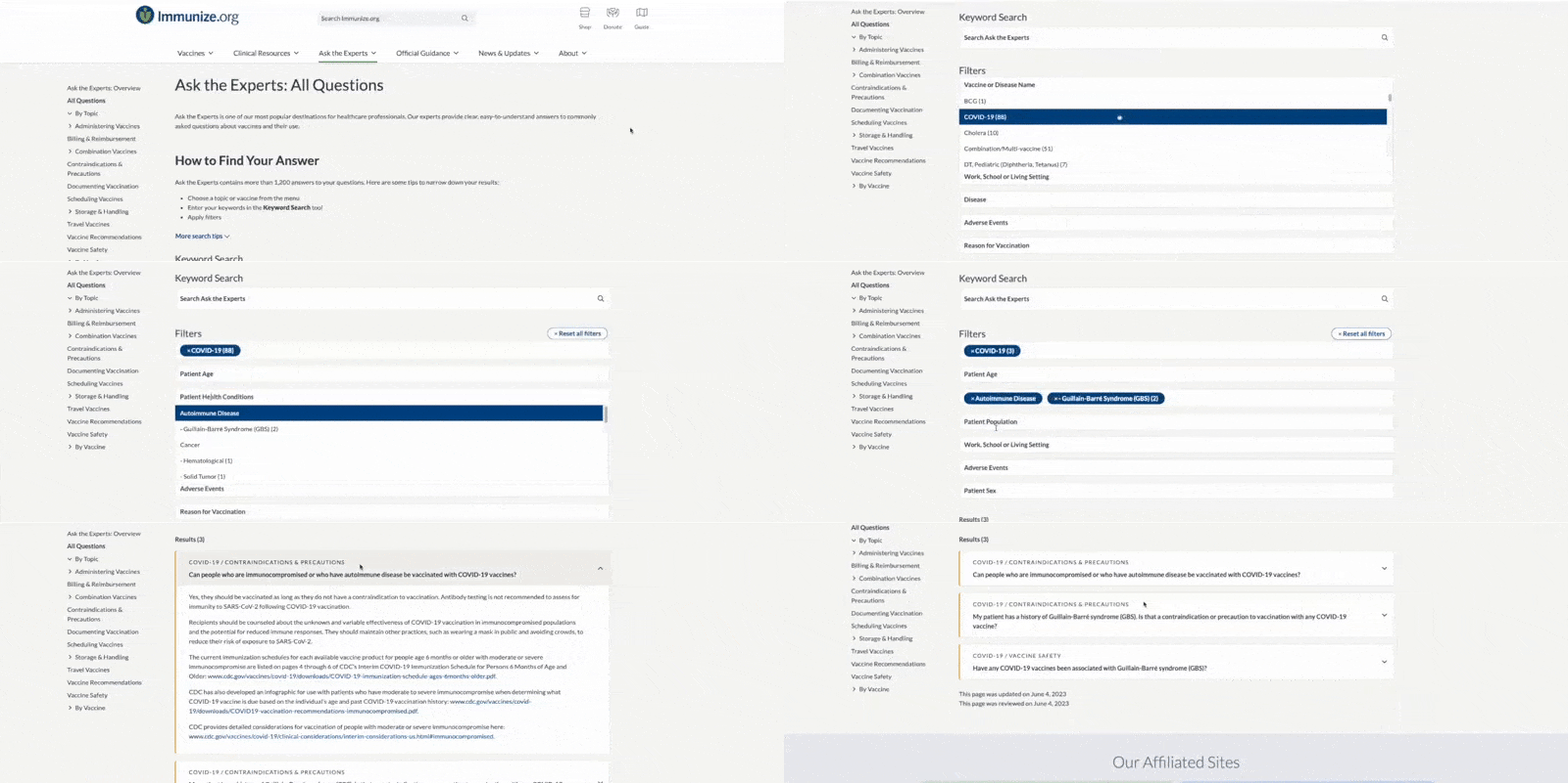
- “Does a Patient’s Report of Past Measles Infection Count as Proof of Immunity?” New in the Ask the Experts Video Series on YouTube.
- Journalists interview Immunize.org experts
- Vaccines in the news
- Needle anxiety is common at any age. Use Immunize.org’s clinical resources to offer a positive vaccination experience.
- Busy with influenza vaccinations? Need VIS translations? Download and print Immunize.org’s free QR code table that links directly to all injectable influenza VIS translations.
- NFID releases podcast on lessons from African scientists about vaccines, misinformation, and building global scientific capacity
- Help Immunize.org reach more vaccinators through your social media networks. Follow us and share our posts on Facebook, Instagram, and LinkedIn!
- Immunize.org lifetime immunization record cards available for patient-held records
- Virtual: Summit Adult Vaccine Recommendations Review (SAVRR) Council will host its second public webinar on October 20, 2:00–3:00 p.m. (ET)
- Virtual: NFID hosts webinar titled “Building Trust to Increase Immunization Uptake” on October 27 at 2:00 p.m. (ET), CME credit offered
- Virtual: American Lung Association will host a webinar titled “Preparing for the Respiratory Virus Season” on October 27 at 11:00 a.m. (ET)
- Register for Immunize.org Website Office Hours. Join a 30-minute discussion about the VIS web section on November 11 at 4:00 p.m. (ET) or November 12 at 12:00 p.m. (ET). Recorded sessions archived.
Immunize.org continues to update its resources to support fall respiratory virus vaccination providers. Two new standing orders templates for administering 2026–27 COVID-19 vaccine are now available:
- Standing Orders for Administering 2026–2027 COVID-19 Vaccine to Children 6 Months Through 18 Years
- Standing Orders for Administering 2026–2027 COVID-19 Vaccine to Adults 19 Years and Older
This season, Immunize.org’s two COVID-19 standing orders templates are organized by age; each template incorporates all available products. They are based on the recommendations of the American Academy of Pediatrics (AAP), the American Academy of Family Physicians (AAFP), and the American College of Obstetricians and Gynecologists (ACOG). Supplemental information from CDC’s updated interim clinical considerations is also included as needed.
The standing orders templates advise referring for clinical evaluation people who are moderately or severely immunocompromised. Vaccination is recommended for this population. However, the Infectious Diseases Society of America (IDSA) guidelines for COVID-19 vaccination provide several individualized clinical considerations around timing and numbers of doses not adaptable to a routine standing order. CDC posts current dosing tables and schedules for adults and children who are moderately or severely immunocompromised. Immunize.org plans a separate job aid reproducing the CDC dosing tables for this population to assist those who serve them.


Immunize.org also updated its Checklist of Current Versions of U.S. COVID-19 Vaccination Guidance and Clinic Support Tools. Download this checklist now to ensure you are using the latest resources for the 2026–27 season. The checklist includes revision dates and links to the new standing orders, current AAP, AAFP, ACOG, and IDSA recommendations, and other essential 2026–27 resources.

Related Links
- Immunize.org: Vaccines A–Z: COVID-19 main page
- Immunize.org: Healthcare Professional Organization Vaccine Recommendations main page
Montana reports unvaccinated child’s death from complications of Haemophilus influenzae type b (Hib) infection
On October 5, the Montana Department of Public Health and Human Services (DPHHS) reported that an unvaccinated child died in September from complications of Haemophilus influenzae type b (Hib) infection. DPHHS is not releasing the child’s age, sex, or county of residence. Invasive Hib disease is extremely rare, with U.S. cases declining by more than 99% since licensure of a highly effective infant vaccine in 1989. The most recent final surveillance report from CDC listed only 14 cases of Hib in all age groups in 2024. Only Hib is vaccine-preventable; almost all Haemophilus influenzae disease is caused by other types or non-typeable strains.
State Medical Officer Douglas Harrington, MD, said in an article published by the Daily Montanan that the death is a reminder that these diseases still exist “and can have devastating consequences.” He urged parents to work with their child’s healthcare provider to stay up to date on all recommended vaccines, including Hib.
The American Academy of Pediatrics (AAP) and American Academy of Family Physicians (AAFP) schedules recommend a routine 2- or 3-dose primary Hib vaccine series (depending on product) beginning at age 2 months, with a final booster dose at age 12–15 months. Unvaccinated or incompletely vaccinated children younger than age 5 years should get a catch-up dose. Some older children and adults with certain medical conditions, such as those who have had a stem cell transplant, also need Hib vaccine.
Related Links
- DPHHS: Montana Reports Pediatric Death from Hib Infection (10/5/26)
- Daily Montanan: Child Dies from Bacterial Infection, State Health Department Reports (10/5/26)
- LetsGetRealAboutVaccines.org: Hib (Haemophilus Influenzae Type B) web page
- VaccineInformation.org: Hib (Haemophilus Influenzae Type B) web page
Respiratory diseases: Influenza is rising early in the United States and abroad. Vaccinate now to allow time for immunity to develop.
In the United States, for the week reported on October 9, influenza activity remains low but is increasing in several parts of the country. In the United Kingdom, emergency department visits for influenza-like illness are above seasonally expected levels. In Japan, influenza activity began rising in August, the second-earliest start since record-keeping began in 1999, and outbreaks closed some schools as students returned from summer break.
Influenza activity is increasing, so don't put off vaccination. Vaccination generally takes 2 weeks to induce immunity, so act now. Use simultaneous vaccination or make a plan to get up to date with other respiratory vaccines needed: COVID-19, and, if eligible, pneumococcal and RSV vaccines.
The map below shows the general levels of influenza-like illness activity across the states as of October 3.

The graph below shows the trends in the percent of positive tests for COVID-19 (orange: no recent increase), influenza (blue: rising), and RSV (maroon: negligible activity).

Respiratory Illness Data Channel
CDC's Respiratory Illness Data Channel web page shows a snapshot of the amount of acute respiratory illness (ARI) causing people to seek health care in the United States. Local data are available by state or territory and by county. CDC reports:
- COVID-19: activity remains elevated in some regions but is declining nationally
- Influenza: activity increasing in many parts of the country but remains low
- RSV: activity very low in most areas of the country
- Rhinovirus/enterovirus (RV/EV): activity increasing nationally
How to Find a Vaccine
VaccineInformation.org, Immunize.org's website designed for the general public, offers the Where to Get Vaccinated web page. On this page, you will find directories and vaccine finder tools published by various organizations, including manufacturers, to help you locate a convenient place to access vaccinations now.
Those who may have used or promoted the federal website Vaccines.gov, to locate vaccination sites in the past should be aware that it is not functional, and its Spanish-language counterpart, Vacunas.gov, is no longer available.
Related Links
- CDC: Weekly National Flu Vaccination Dashboard main page
- CDC: FluView main page
- CDC: RESP-NET main page
- Immunize.org: Clinical Resources: Seasonal Vaccines (Influenza, RSV, COVID-19) main page
Measles 2026: Johns Hopkins University reports 4,267 confirmed cases; Pennsylvania becomes the first state in 35 years to surpass 1,000 cases
As of October 7, 2026, the U.S. Measles Tracker, operated by Johns Hopkins University (JHU), reported 4,267 measles cases for 2026. Through October 8, 2026, CDC reported 4,080 confirmed cases.
On October 7, the Pennsylvania Department of Health reported 1,078 confirmed measles cases across 41 of its 67 counties in 2026, including 207 hospitalizations and five measles-associated deaths. Only four cases (less than 1%) occurred in vaccinated people.
Adults continue to drive Pennsylvania’s outbreak. Only 32% of cases involved children younger than age 18, and most cases were in people age 25–49. Pennsylvania’s vaccination providers gave more than 56,000 MMR doses in September, more than twice the typical monthly total of about 25,000. Adults with only one documented dose of MMR, or without vaccination records, should talk with a healthcare provider about vaccination.
Measles activity is also prompting action beyond Pennsylvania. On October 5, New York Governor Kathy Hochul declared a state disaster emergency in response to outbreaks in rural areas of New York and neighboring states, where 108 cases have been confirmed. This declaration allows the state to immediately expand its network of vaccine administrators, adding paramedics, advanced emergency medical service providers, midwives, and pharmacists, as well as adding the flexibility for registered nurses to order measles testing.
The graph below, published at the JHU U.S. Measles Tracker website, illustrates how quickly 2026 cases are outstripping the pace set in 2025.

- CDC: Measles Cases and Outbreaks main page
- Immunize.org: Vaccines A–Z: Measles main page
- LetsGetRealAboutVaccines.org: Measles web page
- CDC: Be Ready for Measles Toolkit
- AAP: Immunization Facts for Families (MMR) (PDF)
“Does a Patient’s Report of Past Measles Infection Count as Proof of Immunity?” New in the Ask the Experts Video Series on YouTube.
This week, our featured episode from the Ask the Experts Video Series is titled Does a Patient’s Report of Past Measles Infection Count as Proof of Immunity? The video explains that a personal history of measles, mumps, or rubella is not acceptable proof of immunity. Acceptable proof for school-aged children, college students, international travelers, and healthcare workers is written documentation of two MMR doses (for measles and mumps) or, for rubella, at least one rubella-containing dose or a positive antibody blood test. People born before 1957 are generally considered immune. Healthcare facilities may require workers of all ages to show proof of vaccination or immunity to prevent workplace transmission.
The 1-minute video is available on our YouTube channel, along with our full collection of quick video answers to popular Ask the Experts questions.

Like, follow, and share Immunize.org’s social media accounts and encourage colleagues and others interested in vaccination to do likewise.
- Facebook at ImmunizeOrg
- Instagram at ImmunizeOrg
- LinkedIn at ImmunizeOrg
- YouTube at ImmunizeOrg
- Immunize.org: Ask the Experts: all MMR-related video questions (2 videos)
Journalists seek out Immunize.org experts to help explain vaccines to the public and policy makers. We help the media understand and communicate the complex work vaccinators do. Here is a recent citation.
- New York Times: Texas Pediatricians Face Paxton Investigations for Vaccinating Children (10/5/26)
These recent articles convey the potential risks of vaccine-preventable diseases and the importance of vaccination.
- The Guardian: Controversial Vaccine Trial Touted by RFK Jr Gets Go-Ahead in Guinea-Bissau (10/9/26)
- Medical Xpress: Value-Aligned Messages Increased COVID-19 Vaccination Intentions, Study Finds (10/8/26)
-
Gavi, The Vaccine Alliance: Eight Numbers That Explain the Impact of Gavi, the Vaccine Alliance in 2025 (10/7/26)
- Washington Post: Pennsylvania’s Measles Outbreak Looks Scary. Doctors Say the Reality Is Worse. (10/6/26)
- Washington Post: Measles Can Erase up to 73 Percent of Your Immune System’s Memory (10/5/26)
- New York Times: Measles Outbreak in Amish Country Forces Some to Rethink Vaccines (10/4/26)

This week, we continue to spotlight our Getting Started: For the New Vaccinator web pages, highlighting the "Vaccine Storage and Handling" and "Learn More" pages. These topics can be accessed under the Clinical Resources dropdown menu found at the top of each page:

New vaccinators have varying levels of involvement in vaccine storage and handling, but they should all understand the protocols that prevent costly damage and vaccine waste. Immunize.org Storage and Handling Resources include checklists, reference documents, and temperature logs. External Resources from the CDC and the California Department of Public Health provide detailed best practices and guidance for every setting where vaccines are administered.
For administrators, trainers, or anyone seeking support beyond basic training, check out Getting Started: Learn More. Key resources from Immunize.org, CDC, California Department of Public Health, and the Children’s Hospital of Philadelphia Vaccine Education Center will help build knowledge and confidence.

Getting Started: For the New Vaccinator provides an easy entry point for healthcare professionals across clinical backgrounds to build confidence and skills.
For a brief overview of the entire section, view the short video, Introducing Immunize.org's Getting Started: For New Vaccinators Web Pages (2:28).
Immunize.org completed updates to our suite of influenza clinical resources for the 2026–27 season with the posting of the 2026–27 Influenza: Questions and Answers resource.
Ask the Experts questions included in the September 25 Special Edition of IZ Express were updated in the Ask the Experts web section. Updates of the entire Ask the Experts Influenza, RSV, and COVID-19 sections are forthcoming.
These updated 2026–27 season resources were previously announced in IZ Express:
- Declination of Influenza Vaccination
- Don’t Take Chances with Your Family’s Health—Make Sure You All Get Vaccinated
- Guide for Determining the Number of Doses of Influenza Vaccine to Give to Children Age 6 Months Through 8 Years
- How to Administer Intramuscular and Intranasal Influenza Vaccines
- How to Administer Intranasal and Oral Vaccinations
- Influenza Vaccine Products for the 2026–2027 Influenza Season
- Not Sure If You Can Get an Influenza Vaccine?
- Communicating the Benefits of Influenza Vaccination
- Screening Checklist for Contraindications to Injectable Influenza Vaccine (Inactivated “IIV,” Cell Culture “ccIIV,” Recombinant “RIV,” or mRNA)
- Screening Checklist for Contraindications to Live Attenuated Intranasal Influenza Vaccination
- Standing Orders for Administering Influenza Vaccine to Adults
- Standing Orders for Administering Influenza Vaccine to Children and Teens
- Talking with Your Patient about Contraindications and Precautions to Influenza Vaccination
Find each of our influenza vaccine resources for the 2026–27 season at the Vaccines A–Z: Influenza main page.
Remember to use Immunize.org's new Seasonal Vaccines topic filter to access all influenza, RSV, and COVID-19 clinical resources for the 2026–27 respiratory season.
In Clinical Resources: Improving the Vaccination Experience, Immunize.org provides print and video tools to create a positive vaccination experience and ease injection anxiety in children and adults. Links to additional resources from trusted partner organizations are also provided.
The web page links to eight printable resources on addressing vaccination anxiety (four for providers, four for recipients; each available in English and Spanish), two in-depth webinars, and six brief videos (listed below). As with all Immunize.org resources, these are free to download, link, copy, and share.

The video topics include:
- How to Administer Multiple Intramuscular Vaccines to Adults During One Visit (3:47)
- Using Enhanced Screening Checklists for Contraindications to Vaccination (3:10)
- Addressing Vaccination Anxiety for Infants: Strategies for Vaccine Recipients and Caregivers (4:07)
- Addressing Vaccination Anxiety: Strategies for Healthcare Professionals (3:29)
- Fainting Related to Vaccination: What You Need to Know (3:24)
- Addressing Vaccination Anxiety for Children: Strategies for Vaccine Recipients and Caregivers (3:26)
Related Links
- Immunize.org: Clinical Resources: Addressing Vaccination Anxiety main page
- Immunize.org: Clinical Resources: Vaccine Confidence main page
Busy with influenza vaccinations? Need VIS translations? Download and print Immunize.org’s free QR code table that links directly to all injectable influenza VIS translations.
One document puts every available translation of the injectable influenza vaccine VIS at your fingertips as you prepare for influenza vaccination clinics this fall. Be ready to offer influenza vaccine information in their preferred language to almost any client who walks in.
Titled QR Code Links to Vaccine Information Statement (VIS) Translations: Influenza (Flu) Vaccine (Inactivated or Recombinant), this 3-page PDF assembles QR codes for 44 injectable influenza VIS translations. Page one leads off with basic instructions, along with the QR code to the required English VIS and the most popular VIS translation, Spanish. Pages two and three provide the QR codes for each additional language option, along with a few additional VIS resources.
Each QR code is labeled with the language name in English and in the corresponding language. This allows vaccine recipients who do not read English to locate and scan the code for their preferred language with their own smartphone.


This resource does not go out of date. If a VIS is updated, the QR code will automatically link to the current version available online at Immunize.org. Download this resource today as you prepare for influenza vaccination clinics this fall.
Related Links
- Immunize.org: Vaccines A–Z: Influenza web page
- Immunize.org: Clinical Resources A–Z main page, where you can filter by topic, vaccine, language, or other criteria
NFID releases podcast on lessons from African scientists about vaccines, misinformation, and building global scientific capacity
On October 7, NFID posted a podcast in its Infectious IDeas series titled Vaccines, Equity, and Africa's Scientific Future. Shabir A. Madhi, MMed, PhD, professor of vaccinology, University of the Witwatersrand in Johannesburg, South Africa, and recipient of the 2026 NFID Maxwell Finland Award for Scientific Achievement, joined NFID CEO Rebecca Alvania, PhD, MA, and NFID Medical Director Robert H. Hopkins, Jr., MD, to discuss what African scientists can teach us about the power of vaccines, the threat of misinformation, and the need to build scientific capacity around the world.

Immunize.org offers a social media program to highlight our educational resources for a broad audience of vaccinators. Our social media channels now feature our most popular printable resources and Ask the Experts questions, as well as announcements important to frontline vaccinators. Please view and share our newest feature, the Ask the Experts Video Series.


Like, follow, and share Immunize.org’s social media accounts and encourage colleagues and others interested in vaccination to do likewise:
- Facebook at ImmunizeOrg
- Instagram at ImmunizeOrg
- LinkedIn at Immunize.org
- YouTube at ImmunizeOrg
Immunize.org offers wallet-sized Lifetime Immunization Record Cards, printed on rip-proof, smudge-proof, waterproof paper designed to last a lifetime. Sold in boxes of 250.

To purchase record cards, please visit the Immunize.org Shop.
Related Link
- Immunize.org: Shop Immunize.org main page
In its August 18 issue, Nature Medicine published County, District and Community-Level Measles Transmission in the United States in 2013−2025. The article highlights the importance of examining measles vaccination rates at the school or school district level where concentrations of unvaccinated children may exist unrecognized by surveillance systems that only look at county or statewide vaccination rates. A portion of the abstract appears below.
We assembled a nationwide multiscale vaccination database spanning 45 US states and Washington, DC (2013−2025), encompassing over 50,000 schools, 13,000 districts and 3,000 counties, and developed a transmission model to quantify epidemic risk across different spatial scales. School-level effective reproduction numbers crossed the epidemic threshold in 2022−2023, a transition invisible to aggregated surveillance. Average susceptibility doubled from approximately 5% to 10% following the pandemic. We also show that county boundary misalignment creates cross-boundary corridors that push well-vaccinated counties above threshold through spillover from less-vaccinated populations. State trajectories diverge markedly, shaped by exemption policies and vaccination infrastructure. The spatial architecture of US measles vulnerability has fundamentally shifted: transmission potential is supercritical in schools but invisible at the scale monitored by surveillance. Preventing measles re-endemicity requires surveillance and interventions operating at school and district levels, where imported cases can be intercepted before igniting sustained transmission.
Related Link
- Gavi, The Vaccine Alliance: Why High Vaccination Coverage Doesn’t Always Mean Low Measles Risk (10/5/26)
The Summit Adult Vaccination Recommendations Review (SAVRR) Council will host its second public webinar online, 2:00–3:00 p.m. (ET) on October 20. The meeting will present:
- An overview of fall respiratory vaccine recommendations developed by medical societies
- The SAVRR Council’s implementation considerations for the 2026–27 fall respiratory season
- A look at plans for future open meetings and opportunities for ongoing engagement
The SAVRR Council, a committee of the National Adult and Influenza Immunization Summit (NAIIS or “the Summit”), is a group of representatives of diverse organizations that deliver vaccinations to adults. It meets to discuss vaccination implementation challenges and provide implementation guidance to support vaccinators who are following recommendations issued by medical societies. Immunize.org administers and serves as the fiscal agent for the Summit and the SAVRR Council.
Virtual: NFID hosts webinar titled “Building Trust to Increase Immunization Uptake” on October 27 at 2:00 p.m. (ET), CME credit offered
NFID will host a webinar titled Building Trust to Increase Immunization Uptake at 2:00 p.m. (ET) on October 27. The panel includes NFID Medical Director Robert (Bob) H. Hopkins, Jr., MD; Audrey M. Stevenson, PhD, MPH, NFID director; Allison L. Hill, PharmD, director of practice and professional affairs, American Pharmacists Association; Amanda M. Kwong, MPH, director of the Public Health, Communications Collaborative; and Chelsea B. Cipriano, MPH, executive director, Common Health Coalition. The speakers will discuss communication strategies that build trust and counter misinformation about vaccine-preventable diseases.

CME credit is available. There is no fee, but preregistration is required. Register for the webinar.
NFID hosts monthly webinars to increase awareness of the importance of infectious disease prevention and treatment. CME, CNE, and CPE credits are available for select recordings. View archived NFID webinars.
American Lung Association and partners will host a webinar titled Preparing for the Respiratory Virus Season at 11:00 a.m. (ET) on October 27. The presenters include Eric J. Chow MD, MPH, chief of communicable disease epidemiology and immunization at Public Health – Seattle & King County, and Jennifer Seo, MD, JD, medical advisor, Illinois Department of Public Health. During the webinar, presenters will discuss influenza, COVID-19, and RSV risk factors for severe illness, effective prevention strategies, current vaccination recommendations, and available resources. The webinar will also address frequently asked questions and provide guidance on having informed conversations with healthcare providers about recommended vaccines.
Register for the webinar.
To learn simple tips and tricks for using our websites efficiently, please register for our next set of Website Office Hours on Wednesday, November 11, at 4:00 p.m. (ET) or Thursday, November 12, at 12:00 p.m. (ET). The same content will be discussed in both sessions.
We will open each 30-minute session with a short, live demonstration on navigating the popular VIS website section on Immunize.org. You can submit questions when you register or live on Zoom during the session.

Register today for Immunize.org Website Office Hours (content is the same for both):
The archive of previous Website Office Hours content is posted at Immunize.org’s "Webinars & Videos" page. Shorter, demonstration-only recordings of previous Website Office Hours are also available in our Website Training Videos series.
Mark your calendar for future Immunize.org Website Office Hours.
For more upcoming events, visit our Calendar of Events.
About IZ Express
IZ Express Disclaimer
ISSN 2771-8085
Editorial Information
-
Editor-in-ChiefKelly L. Moore, MD, MPH
-
Managing EditorJohn D. Grabenstein, RPh, PhD
-
Associate EditorSharon G. Humiston, MD, MPH
-
Writer/Publication CoordinatorTaryn Chapman, MS
Courtnay Londo, MA -
Style and Copy EditorMarian Deegan, JD
-
Web Edition ManagersArkady Shakhnovich
Jermaine Royes -
Technical ReviewerKayla Ohlde