
Checklist of Current Versions of U.S. COVID-19 Vaccination Guidance and Clinic Support Tools
Checklist of links to key COVID-19 vaccination resources, including the date they were last revised.
Co-branded with AIM (Association of Immunization Managers), this one-page document presents science-based benefits of influenza (flu) vaccination and includes tips on communicating with patients.
Form for healthcare worker signature and date, lists important reasons for annual influenza vaccination and consequences of vaccine refusal
Share this influenza disease overview handout with patients and parents.
This resource provides guides for determining the number of doses of influenza vaccine to give to children ages 6 months through 8 years
This piece is for providers and shows how to administer intramuscular and intranasal influenza vaccines.
Information about influenza vaccine products available in the U.S. during 2026-2027
Information about the disease and vaccines for patients and parents
Two-page illustrated handout for patients which addresses common misunderstandings people give for not getting vaccinated against influenza. There is a companion handout for healthcare professionals Talking with Your Patient about Contraindications and Precautions to Influenza Vaccination
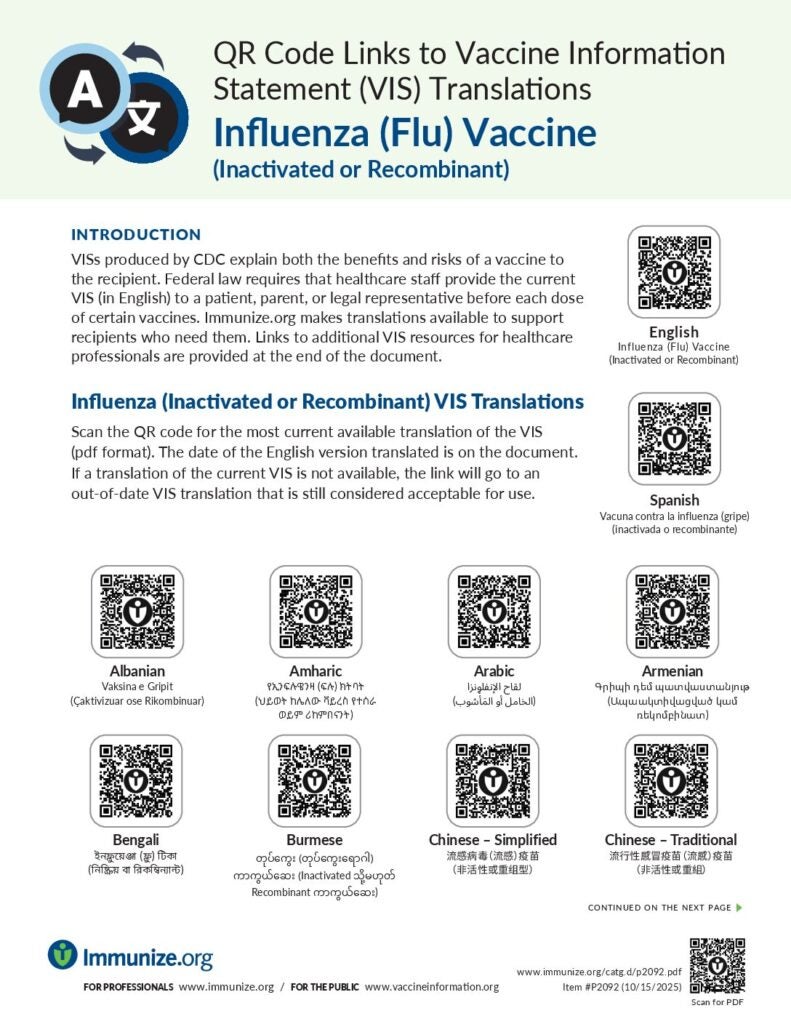
Scan QR codes to access 45 different translations of the Influenza (Flu) Vaccine (Inactivated or Recombinant) Vaccine Information Statement (VIS). Additional links are provided to VIS resources for healthcare professionals.
Form your patients fill out to help you evaluate if influenza vaccine can be given at that day’s visit, includes information sheet for healthcare professionals
Form your patients fill out to help you evaluate if live attenuated influenza vaccine (LAIV) can be given at that day’s visit, includes information sheet for healthcare professionals
Eligible healthcare professionals may administer Nuvaxovid (Sanofi-Novavax) COVID-19 vaccine to individuals 12 years of age and older, following clinical guidance from CDC (Interim Clinical Considerations for Use of COVID-19 Vaccines). A list of high-risk conditions supported by evidence is provided, along with a list of conditions that should trigger use of the dosing schedule for people with moderate or severe immunocompromise. CDC recommends COVID-19 vaccination of any person age 6 months or older following a shared clinical decision-making discussion. Links to current COVID-19 vaccine recommendations from AAP, AAFP, IDSA, and ACOG are also provided. These organizations recommend routine vaccination for designated people at increased risk of infection or severe disease and shared clinical decision-making for those at lower risk.
Eligible healthcare professionals may administer mRNA COVID-19 vaccines to children 6 months through 11 years, following clinical guidance from CDC (Interim Clinical Considerations for Use of COVID-19 Vaccines). A list of high-risk conditions supported by evidence is provided, along with a list of conditions that should trigger use of the dosing schedule for people with moderate or severe immunocompromise. CDC recommends COVID-19 vaccination of any person age 6 months or older following a shared clinical decision-making discussion. Links to current COVID-19 vaccine recommendations from AAP, AAFP, and IDSA are also provided. These organizations recommend routine vaccination for designated people at increased risk of infection or severe disease and shared clinical decision-making for those at lower risk.
Eligible healthcare professionals may administer mRNA COVID-19 vaccines to individuals 12 years of age and older, following clinical guidance from CDC (Interim Clinical Considerations for Use of COVID-19 Vaccines). A list of high-risk conditions supported by evidence is provided, along with a list of conditions that should trigger use of the dosing schedule for people with moderate or severe immunocompromise. CDC recommends COVID-19 vaccination of any person age 6 months or older following a shared clinical decision-making discussion. Links to current COVID-19 vaccine recommendations from AAP, AAFP, IDSA, and ACOG are also provided. These organizations recommend routine vaccination for designated people at increased risk of infection or severe disease and shared clinical decision-making for those at lower risk.
Eligible healthcare professionals may vaccinate infants younger than 8 months of age who meet the criteria established by the American Academy of Pediatrics (AAP) in September 2026 (https://doi.org/10.1542/peds.2026-079047), for immunization with a long-acting preventive antibody against RSV (clesrovimab, brand name Enflonsia, by Merck).
Eligible healthcare professionals may vaccinate adults who meet the criteria established in September 2026 by the American Academy of Family Physicians (AAFP), American College of Obstetricians and Gynecologists (ACOG), and Infectious Diseases Society of America (IDSA), and 2026–27 season clinical considerations published by the Centers for Disease Control and Prevention.
Eligible healthcare professionals may vaccinate children and teens who meet any of the criteria on this form
Eligible healthcare professionals may vaccinate all infants and high-risk young children who meet the criteria established by the American Academy of Pediatrics (AAP) in September 2026 (https://doi.org/10.1542/peds.2026-079047), for immunization with a long-acting preventive antibody against RSV (nirsevimab, brand name Beyfortus, by Sanofi), with information provided on current CDC recommendations.
Eligible healthcare professionals may vaccinate all pregnant women who meet any of the criteria on this form. This template is consistent with the recommendations of the American College of Obstetricians and Gynecologists.
Eligible healthcare professionals may vaccinate adults age 50 years and older who meet the criteria established by the CDC’s Advisory Committee on Immunization Practices. These criteria are consistent with the September 2026 recommendations of the American Academy of Family Physicians (AAFP).
This handout is designed to be a companion to Not Sure If You Can Get an Influenza Vaccine? It provides key information to help the provider determine if an influenza vaccine can or should be provided to the patient.