


Ask the Experts: Immunize.org Answers Questions About Measles, Mumps, Rubella, and MMR Vaccination
As an additional service to IZ Express readers, we periodically publish special editions such as this one, providing you with Ask the Experts questions and answers from Immunize.org experts. This issue includes 14 Q&As about measles, mumps, rubella, and the MMR vaccine.
To find the full set of Immunize.org's Ask the Experts Q&As related to MMR, visit www.immunize.org/ask-experts/topic/MMR.
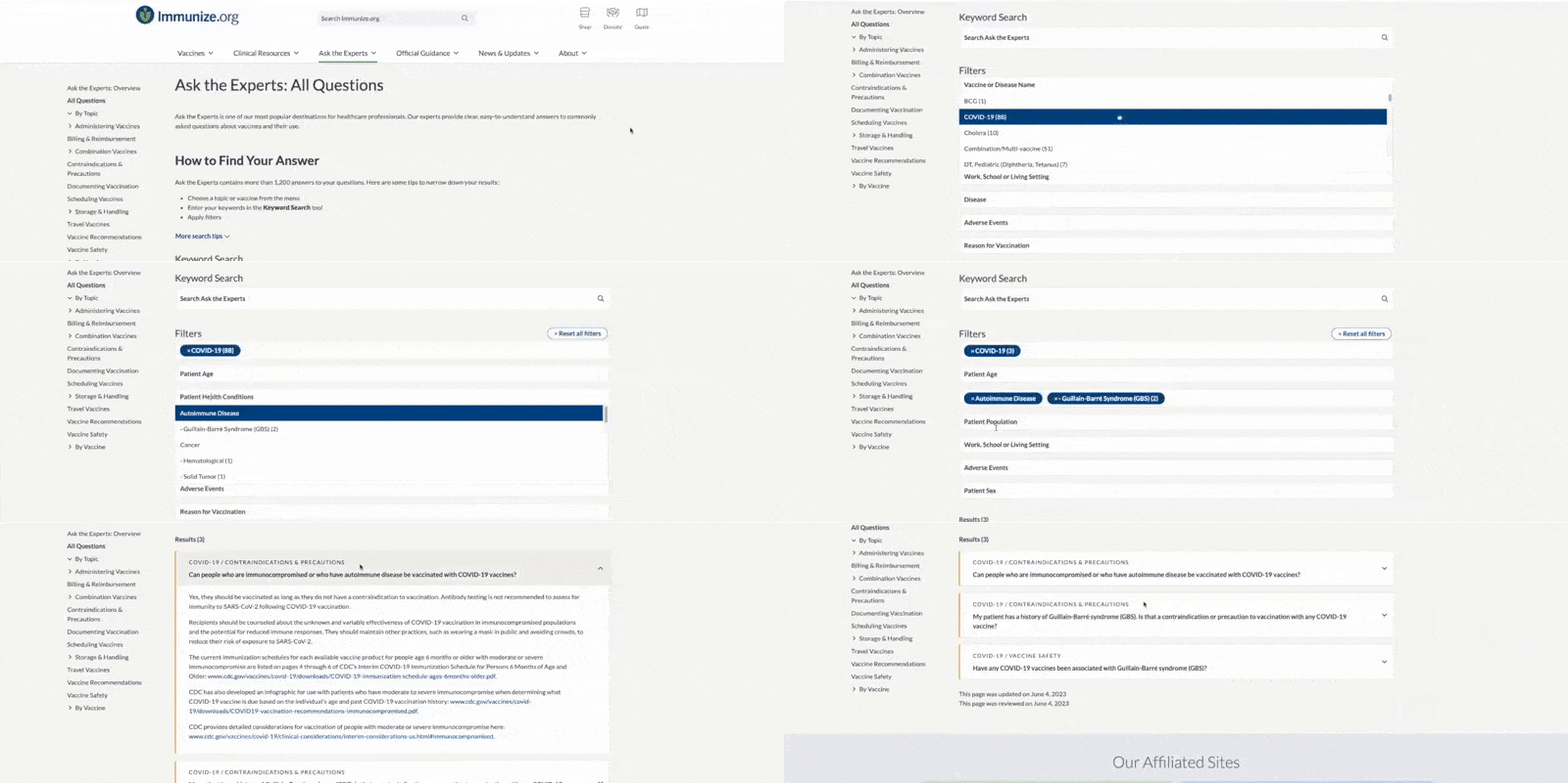
You can find all of these questions and answers, plus more than 1,300 others about vaccines and vaccine administration, on our "Ask the Experts" main page at www.immunize.org/ask-experts.
Immunize.org's team of experts includes Kelly L. Moore, MD, MPH (team lead); Carolyn B. Bridges, MD, FACP; Iyabode Beysolow, MD, MPH; and Jane R. Zucker, MD, MSc.
- Q: What is the current situation with measles, mumps, and rubella in the United States?
- Q: What should our clinic do if we suspect a patient has measles?
- Q: How long does it take to show signs of measles, mumps, and rubella after being exposed?
- Q: What is considered acceptable evidence of immunity to measles?
- Q: If there is a measles outbreak in my area, can we vaccinate children younger than 12 months?
- Q: How does being born before 1957 confer immunity to measles?
- Q: Why is a second dose of MMR necessary for children and others at increased risk?
- Q: A patient planning for pregnancy has documentation of two age-appropriate doses of MMR vaccine but has a negative rubella titer. Should we revaccinate her?
- Q: We have measles cases in our community. How can I best protect the young children in my practice?
- Q: Does the 4-day "grace period" apply to the minimum age for administration of the first dose of MMR? What about the 28-day minimum interval between doses of MMR?
- Q: If a 5-year-old child has never received any doses of MMR or varicella vaccine and now the parents want him to catch up with the combination vaccine MMRV, what is the spacing requirement between the two doses?
- Q: What is the recommendation for MMR vaccine for healthcare personnel?
- Q: A few parents are asking that their children receive separate components of the MMR vaccine because they fear MMR may be linked to autism. What should I do?
- Q: [Video] Do Any Adults Who Were Vaccinated or Who Had Measles in Childhood Need “Booster” Doses of MMR Vaccine to Prevent Measles Now?
A: The United States is experiencing a large increase in measles cases. In 2025, CDC received reports of 2,288 confirmed measles cases. This was the largest number of confirmed cases reported since 1992, the year after the last measles resurgence in 1989–1991. In 2025, there was a total of 48 outbreaks in 44 states; one large outbreak of 762 confirmed cases occurred in Texas. In 2026, the United States exceeded the 2025 total just over halfway through the year. One large outbreak occurred in South Carolina, started in 2025 and ended in 2026, with a total of 997 cases. Utah reported 197 cases in 2025 and 516 cases as of August 4, 2026, with ongoing, uninterrupted transmission occurring for more than 12 months. Outbreaks have occurred in close-knit, under-vaccinated communities, and true case numbers are known to be higher than confirmed case counts due to under-reporting in some communities. By contrast, during the COVID-19 pandemic, global travel and social interactions were sharply reduced, and there were fewer opportunities for introduction and transmission of measles, mumps, and rubella viruses in the United States.
Current CDC measles surveillance updates can be found at www.cdc.gov/measles/data-research/. The U.S. Disease Tracker website (https://usdiseasetracker.org) is a collaboration among the Council of State and Territorial Epidemiologists (CSTE), Association of State and Territorial Health Officials (ASTHO), and Johns Hopkins University. It provides interactive state-level surveillance data for multiple diseases, including measles.
Since the pre-vaccine era, there has been a more than 99% decrease in mumps cases in the United States. However, outbreaks still occasionally occur. In 2006, there was an outbreak affecting more than 6,584 people in the United States, with many cases occurring on college campuses. In 2009, an outbreak started in close-knit religious communities and schools in the Northeast, resulting in more than 3,000 cases. Since 2015, numerous outbreaks have been reported across the United States, in college campuses, prisons, and close-knit communities, including a large outbreak in northwest Arkansas where almost 3,000 cases were reported in 2016. These outbreaks have shown that when people with mumps have close contact with a lot of other people (such as among residential college students and families in close-knit communities), mumps can spread, even among vaccinated people. However, outbreaks are much larger in areas where vaccine coverage rates are lower. A provisional total of 354 cases of mumps were reported to CDC in 2025.
Rubella was declared eliminated (the absence of endemic transmission for 12 months or more) from the United States in 2004. Rubella incidence in the United States has decreased by more than 99% from the pre-vaccine era. The number of reported rubella and congenital rubella syndrome (CRS) cases vary each year. From 2022 through 2025, the number of reported cases of rubella has been as low as zero in 2025 and as high as 16 in 2024 (provisional data). No cases of CRS were reported in 2022, 2023 or 2024 (provisional data); one case of CRS was reported in 2025 (provisional data).
A: Measles is highly contagious. A person with measles is infectious up to 4 days before through 4 days after the day of rash onset. Patients with suspected measles should be isolated for 4 days after they develop a rash. Airborne precautions should be followed in healthcare settings by all healthcare personnel. The preferred placement for patients who require airborne precautions is in a single-patient airborne infection isolation room. Providers should immediately isolate and report suspected measles cases to their local health department. CDC recommends that either a nasopharyngeal swab, throat swab, or urine specimen as well as a blood specimen be collected from all patients with clinical features compatible with measles. Nasopharyngeal or throat swabs are preferred over urine specimens.
CDC has materials to help healthcare facilities prepare for the possibility of a measles case at www.cdc.gov/measles/php/toolkit/index.html (see Checklist for Healthcare Workers). A number of alternative strategies to more safely evaluate a patient with suspected measles for small medical facilities or practices lacking airborne isolation rooms have been identified. These include seeing the patient at the end of the day after other patients have left, using a separate entrance if available, seeing them outside, home visits, and effective use of a portable HEPA filter system. An exam room where a patient suspected of having measles was seen, should be disinfected and not used for at least 2 hours after the patient has left.
Measles is a nationally notifiable disease in the United States; healthcare providers should report all cases of suspected measles to public health authorities immediately to help reduce the number of secondary cases. Do not wait for the results of laboratory testing to report clinically suspected measles to the local health department.
More information on measles disease, diagnostic testing, and infection control can be found at www.cdc.gov/measles/hcp/clinical-overview/index.html. Information on public health measles surveillance and case investigation is available at www.cdc.gov/surv-manual/php/table-of-contents/chapter-7-measles.html.
A: For measles, there is an average of 10 to 12 days from exposure to the appearance of the first symptom, which is usually fever. The measles rash doesn't usually appear until approximately 14 days after exposure (range: 7 to 21 days), and the rash typically begins 2 to 4 days after the fever begins. The incubation period of mumps averages 16 to 18 days (range: 12 to 25 days) from exposure to onset of parotitis. The incubation period of rubella is 14 days (range: 12 to 23 days). However, up to half of rubella virus infections cause no symptoms.
A: Acceptable presumptive evidence of immunity against measles includes at least one of the following:
- Written documentation of adequate vaccination:
- One or more doses of a measles-containing vaccine administered on or after the first birthday for preschool-age children and adults not at high risk
- Two doses of measles-containing vaccine for school-age children, adolescents, and adults at high risk, including college students, healthcare personnel, international travelers, people with HIV infection, and close contacts of immunocompromised people
- Laboratory evidence of immunity
- Laboratory confirmation of measles (verbal history of measles does not count)
- Birth before 1957
Although birth before 1957 is considered acceptable evidence of measles immunity, healthcare facilities should consider vaccinating unvaccinated personnel born before 1957 who do not have other evidence of immunity with 2 doses of MMR vaccine (minimum interval 28 days).
During an outbreak of measles, healthcare facilities should recommend 2 doses of MMR vaccine at the appropriate interval for unvaccinated healthcare personnel regardless of birth year if they lack laboratory evidence of measles immunity.
A: MMR can be given to children as young as age 6 months who are at high risk of exposure, such as during international travel or a community outbreak. However, doses given more than 4 days before the first birthday cannot be counted toward the 2-dose series for MMR. The first of two routine MMR vaccine doses will be due after age 12 months and at least 4 weeks after the earlier dose. State or local health departments provide guidance to healthcare providers and the public about when to consider early vaccination in an outbreak setting.
A: People born before 1957 lived through several years of epidemic measles before the first measles vaccine was licensed in 1963. As a result, these people are very likely to have had measles infection. Serosurveys suggest that 95% to 98% of those born before 1957 are immune to measles. People born before 1957 can be presumed to be immune. However, if serologic testing indicates that the person is not immune, at least 1 dose of MMR should be administered.
A: Approximately 7% of people do not develop measles immunity after the first dose of vaccine. The second dose is given to provide another chance to develop measles immunity for people who did not respond to the first dose. About 97% of people develop immunity to measles after two doses of measles-containing vaccine.
A: CDC recommends that women of childbearing age who have received 2 doses of rubella-containing vaccine and have rubella serum IgG levels that are not clearly positive should receive 1 additional dose of MMR vaccine (maximum of 3 doses). Testing for serologic evidence of rubella immunity after administration of the additional MMR dose is not recommended. MMR should not be administered during pregnancy.
A: First of all, make sure all your patients are fully vaccinated.
In certain circumstances, MMR is recommended for infants age 6 through 11 months. Follow the guidance of your state or local health department concerning vaccinating infants in this age group in your specific outbreak situation. Do not count any dose of MMR vaccine as part of the 2-dose series if it is administered more than 4 days before a child's first birthday. Instead, repeat the dose when the child is age 12 months, and at least 4 weeks after the early dose.
In the case of a local outbreak, you also might consider vaccinating children age 12 months and older at the minimum age (12 months, instead of 12 through 15 months) and giving the second dose 4 weeks later (at the minimum interval) instead of waiting until age 4 through 6 years.
Finally, remember that infants too young for routine vaccination and people with medical conditions that contraindicate measles immunization depend on high MMR vaccination coverage among those around them. Be sure to encourage all your patients and their family members to get vaccinated if they are not immune.
In addition to these steps, you should be prepared in advance for a suspect measles case to present to your practice. CDC has materials to help healthcare facilities prepare for the possibility of a measles case at www.cdc.gov/measles/php/toolkit/index.html (see Checklist for Healthcare Workers).
A: A dose of MMR vaccine administered up to 4 days before the first birthday may be counted as valid. However, school entry requirements in some states may mandate administration on or after the first birthday. The 4-day "grace period" also may be applied to the 28-day minimum interval between two doses of MMR if the interval is inadvertently shorter than 28 days, although you should never plan to administer the second dose earlier than the 28-day minimum interval. This 4-day "grace period" does not apply to the strict 28-day minimum interval between two different live vaccines (e.g., MMR and varicella vaccines), if not administered at the same visit.
A: Twelve weeks. The spacing between doses of a combination vaccine depends on the longest minimum interval of a component. The minimum interval between doses of MMR is 4 weeks; the minimum interval between doses of varicella vaccine is 12 weeks for a child this age. So, you should wait 12 weeks between the doses of MMRV for the two doses to be valid.
A: ACIP recommends that all healthcare personnel born during or after 1957 have adequate presumptive evidence of immunity to measles, mumps, and rubella, defined as documentation of two doses of measles and mumps vaccine and at least one dose of rubella vaccine, laboratory evidence of immunity, or laboratory confirmation of disease. Further, ACIP recommends that healthcare facilities should consider vaccination of all unvaccinated healthcare personnel who were born before 1957 and who lack laboratory evidence of measles, mumps, and/or rubella immunity or laboratory confirmation of disease. During an outbreak of measles or mumps, healthcare facilities should recommend 2 doses of MMR separated by at least 4 weeks for unvaccinated healthcare personnel regardless of birth year who lack laboratory evidence of measles or mumps immunity or laboratory confirmation of disease. During outbreaks of rubella, healthcare facilities should recommend 1 dose of MMR for unvaccinated personnel regardless of birth year who lack laboratory evidence of rubella immunity or laboratory confirmation of infection or disease.
A: Merck does not manufacture single antigen measles, mumps, and/or rubella vaccines for the U.S. market. Only combined MMR is available. You should educate parents about the lack of association between MMR and autism. You may provide parents with Immunize.org's parent handout (developed in collaboration with the Autism Science Foundation): “Evidence Shows Vaccines Unrelated to Autism,” found at www.immunize.org/wp-content/uploads/catg.d/p4028.pdf. Immunize.org also has a parent handout specifically for concerns related to MMR and autism, “MMR Does Not Cause Autism: Examine the Evidence,” found at www.immunize.org/wp-content/uploads/catg.d/p4026.pdf.

If you have a question that you think may be of interest to our readers, please send it to us using our online form. We will consider it for inclusion in a future update of the “Ask the Experts” feature.