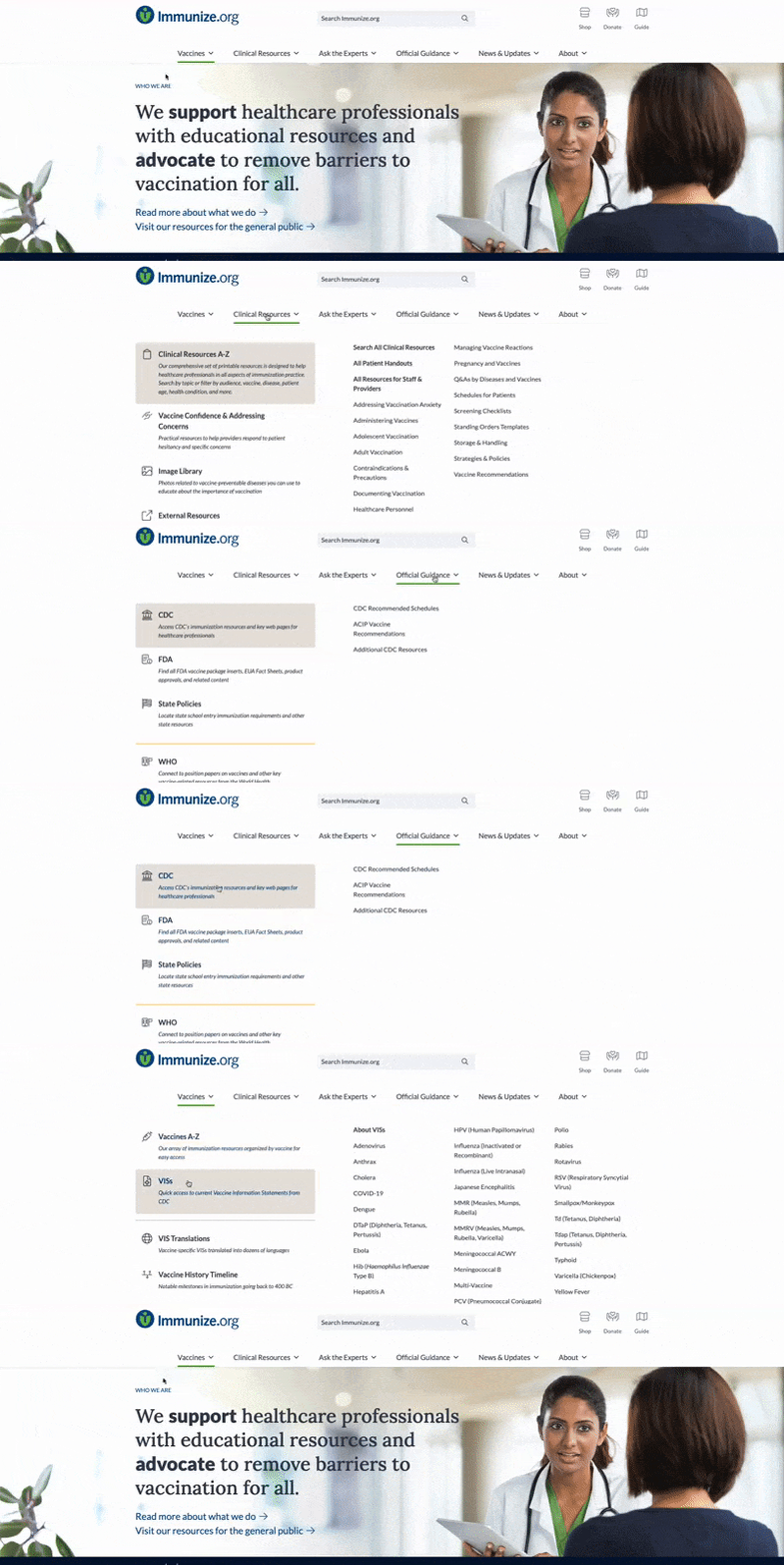


- New! Immunize.org launches new section of website, Getting Started: For the New Vaccinator, with curated content organized for those new to vaccination practice.
- Use Voices for Vaccines’ resources for National Immunization Awareness Month this August
- HHS announces end of COVID-19-related EUAs for certain drugs in 2027; COVID-19 vaccines unaffected
- Measles 2026: 2,170 confirmed measles cases in 39 states and DC; Virginia expands measles outbreak area
- IZ Express keeps readers up to date on evidence-based vaccine information; help us increase our subscribers
- Vaccines in the news
- NFID releases podcast on building trust in an era of misinformation, social media, and artificial intelligence
- Needle anxiety is common at any age. Use Immunize.org’s clinical resources to offer a positive vaccination experience.
- Help Immunize.org reach more vaccinators through your social media networks. Follow us and share our posts on Facebook, Instagram, and LinkedIn!
- Immunize.org lifetime immunization record cards available for patient-held records
- “Fatal Rabies in a Child,” published in Canadian Medical Association Journal
- “Adverse Events After Same-Day COVID-19 and Influenza Vaccination Versus Influenza Vaccination Alone: A Target Trial Emulation” published in Annals of Internal Medicine reports no increase in adverse-event risk with coadministration
- KFF publishes opinion poll results on health information and trust, with update on common vaccine myths
- “Safety and Efficacy of mRNA Vaccines: A Mechanistic and Public Health Perspective” published in Lancet
- Register for Immunize.org Website Office Hours. Join a 30-minute discussion about our VaccineInformation.org and LetsGetRealAboutVaccines.org websites on July 8 at 4:00 p.m. (ET) or July 9 at 12:00 p.m. (ET). Recorded sessions archived.
- Virtual: Decera Clinical Education offers two webinars in July on vaccine confidence and on influenza vaccine uptake; free CE credit offered
Immunize.org is pleased to announce a new section of the website designed for healthcare professionals new to our website or new to vaccination practice, called Getting Started: For the New Vaccinator. Link to the section through the Clinical Resources menu located atop each page. The wide range of resources available at Immunize.org can feel overwhelming to someone new to vaccination practice. This section connects new vaccinators of any clinical background to the basic resources that support each step of successful vaccine delivery.

The Getting Started section is organized into six topic areas:
- Vaccines and the Diseases They Prevent: basic vaccine information, including federal government documents like package inserts
- Vaccinating People Who, When, and How: immunization schedules, vaccine administration job aids, Vaccine Information Statements, and vaccination records
- Responding to Adverse Events: websites and resources needed to address and report a health issue after vaccination, such as an allergic reaction
- Patient Education and Communication: basic sources for patient education and communication resources for healthcare professionals
- Vaccine Storage and Handling: connects to resources essential for proper vaccine storage and handling and responding to vaccine storage problems
- Learn More: immunization information and free resources beyond the basics to get started
In coming issues of IZ Express, Immunize.org will spotlight aspects of the Getting Started section. Visit Getting Started: For the New Vaccinator today and share with anyone new to immunizations or involved in training new staff.
August is National Immunization Awareness Month (NIAM). This annual observance highlights the importance of protecting people of all ages against vaccine-preventable diseases through on-time vaccination. NIAM serves as a focal point for sharing credible information about the importance of staying up to date with routine immunizations.
Voices for Vaccines' (VFV) NIAM 2026 web page serves as a guide to promoting immunization throughout the month. This year's message is that protection from vaccine-preventable diseases gives you one less threat to worry about. The page includes customizable social media graphics and video templates, sample captions, and a weekly posting schedule. It also offers steps to prepare for NIAM in July, including a template proclamation to submit to a governor's office or local lawmaker, and letter-to-the-editor templates for volunteers. VFV encourages partners to share these messages using the hashtags #AskForVax and #NIAM26.

During NIAM, encourage your patients to catch up on annual exams and recommended vaccines. Research shows that healthcare providers remain the most trusted source of vaccine information for parents and patients.
On June 30, HHS announced that it will end the COVID-19 Emergency Use Authorization (EUA) declarations for drugs and medical devices because “the circumstances that justified these emergency measures no longer exist.”
COVID-19 vaccines in use today are now routinely licensed by the FDA, so these changes do not affect COVID-19 vaccines.
The COVID-19-related EUAs for the following products will end in June 2027:
- Vilobelimab (Gohibic, InflaRx), monoclonal antibody
- Pemivibart (Pemgarda, Invivyd), monoclonal antibody
- Molnupiravir (Lagevrio, Merck), antiviral
- Baricitinib (Olumiant, Aurobindo), Janus-kinase enzyme inhibitor
The following products are already approved by the FDA, but their specific COVID-19-related EUAs will end in June 2027:
- Anakinra (Kineret, Sobi), interleukin-1 receptor antagonist
- Nirmatrelvir tablets copackaged with ritonavir tablets (Paxlovid, Pfizer), antiviral
Certain medical devices will have their COVID-19-related EUAs end in December 2026.
You may reassure patients and colleagues that COVID-19 vaccines are not affected by these decisions; every COVID-19 vaccine in use today is FDA-licensed and remains widely available.
Related Link
- HHS: HHS Secretary Kennedy Signs COVID-19 Emergency Use Authorization Declaration Terminations (6/30/26)
U.S. Cases in 2026: As of July 2, CDC reported 36 new measles cases in the previous week, reaching 2,170 confirmed measles cases for 2026. So far, 39 states and the District of Columbia have reported measles cases in 2026. Specific numbers from CDC and state websites differ slightly, as the frequency and timing of federal and state updates vary.
Virginia expands measles outbreak area as it grows: First confirmed in rural Buckingham County on May 13, the outbreak area expanded on June 25 to neighboring Cumberland County. The statewide total reached 129 cases, a jump from just five cases in 2025, making this Virginia’s worst measles year in decades. Of the 106 outbreak cases, all were in people who are unvaccinated or could not confirm their vaccination status. In addition to urging all to follow routine MMR vaccination recommendations, Virginia Department of Health (VDH) recommends early MMR vaccination of age 6- through 11-month-old infants living in or traveling to Buckingham or Cumberland counties.
Below is a map from CDC showing 2026 confirmed cases as of July 25.

Useful Resources: To prepare for measles outbreaks, CDC offers its Be Ready for Measles toolkit. Childcare centers can benefit from this resource: Preparing and Responding to Measles: Checklist for Early Care and Education Centers. This checklist provides step-by-step guidance for preparing for and responding to measles cases in these settings.
Immunize.org offers measles-related resources for the public on several of our affiliated websites:
- VaccineInformation.org: Measles web page
- LetsGetRealAboutVaccines.org: Measles web page
- Immunize.org: Vaccines A–Z: Measles main page
Related Links
- AAP: Fact Checked: The MMR (Measles, Mumps and Rubella) Vaccine Is Safe and Effective web page
- CDC: Measles Cases and Outbreaks main page
- Common Health Coalition: More Illness, Greater Cost: Spotlight Brief: Childhood Immunizations (PDF)
- Johns Hopkins International Vaccine Access Center: U.S. Measles Tracker web page
- Health Canada: Measles and Rubella Weekly Monitoring Report
- CDC: MMWR main page providing access to the MMWR family of publications
Now more than ever, vaccinators need accurate, up-to-date immunization news at their fingertips. Encourage your coworkers to subscribe to IZ Express so they get all the news that matters to vaccinators in their inbox each Wednesday. It’s free!
IZ Express also features:
- Educational materials from Immunize.org and other trustworthy organizations
- Newly posted VISs and their translations
- Notices about educational opportunities, many offering free continuing education credit

Thank you for helping us deliver the latest vaccine news to every clinical and public health professional who needs to know.
These recent articles convey the potential risks of vaccine-preventable diseases and the importance of vaccination.
- FOX: American Vaccines That Transformed Public Health over 250 Years: ‘Outweighs Harm’ (7/1/26)
- BBC: Meningitis Survivor Wants Others to Get Vaccinated (6/30/26)
- Medpage Today: A Flu Season Without ACIP: The Question for Fall (6/29/26)
- KFF Health News: Efforts to End School Vaccine Mandates Hit a Wall in Florida (6/26/26)
- Washington Post: Kids Can Help Fight Vaccine Hesitancy, Too (6/26/26)
- STAT: New ACIP Charter Broadens Criteria for Members, Calls for Review of Alternatives to Vaccines (6/25/26)

This is the 100th edition of the Spotlight series! Each week, we feature a website area that supports your immunization practice.
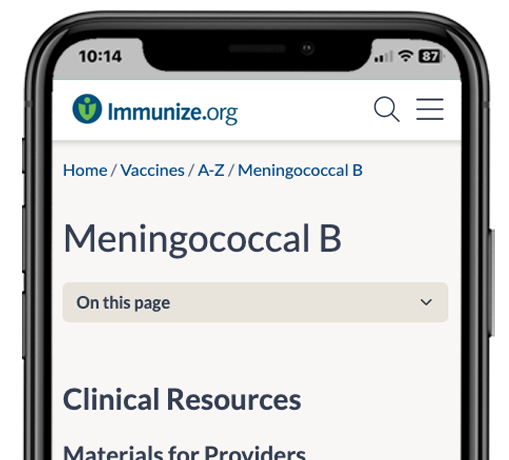
VaccineInformation.org is our educational website for the public, offering straightforward information for people of all ages about vaccine-preventable diseases and vaccines to prevent them.

The site gives information on vaccines for four age groups, shown in the tabs atop each web page and featured on its own main page:
Each of those tabs links to four subsections:
- Vaccines You Need: schedules and other information about the vaccines recommended for that age group, schedule tools, and links to sites that help you find places to get vaccinated
- Resources: handouts from Immunize.org (and available translations), links to content from reputable organizations such as the Vaccine Education Center of the Children’s Hospital of Philadelphia, American Academy of Pediatrics, and Vaccinate Your Family
- Personal Testimonies: real stories from people who experienced vaccine-preventable illness
- Videos: videos filtered by age or disease
Share these pages to help families looking for credible information about vaccines.
On July 2, NFID posted a podcast in its Infectious IDeas series titled Listening to Learn. Heidi J. Larson, PhD, MA, director of the Vaccine Confidence Project and professor at the London School of Hygiene and Tropical Medicine, joins NFID CEO Rebecca Alvania, PhD, MA, and NFID Medical Director Robert H. Hopkins, Jr., MD, to discuss building trust in an era of misinformation, social media, and artificial intelligence.
Drawing on decades of research, Dr. Larson explains why vaccine hesitancy is often a relationship challenge rather than an information problem, and why active listening and trust-building, not just facts, are central to public health.

In Clinical Resources: Improving the Vaccination Experience, Immunize.org provides print and video tools to create a positive vaccination experience and ease injection anxiety in children and adults. Links to additional resources from trusted partner organizations are also provided.
The web page links to eight printable resources on addressing vaccination anxiety (four for providers, four for recipients; each available in English and Spanish), two in-depth webinars, and six brief videos (listed below). As with all Immunize.org resources, these are free to download, link, copy, and share.

The video topics include:
- How to Administer Multiple Intramuscular Vaccines to Adults During One Visit (3:47)
- Using Enhanced Screening Checklists for Contraindications to Vaccination (3:10)
- Addressing Vaccination Anxiety for Infants: Strategies for Vaccine Recipients and Caregivers (4:07)
- Addressing Vaccination Anxiety: Strategies for Healthcare Professionals (3:29)
- Fainting Related to Vaccination: What You Need to Know (3:24)
- Addressing Vaccination Anxiety for Children: Strategies for Vaccine Recipients and Caregivers (3:26)
Related Links
- Immunize.org: Clinical Resources: Addressing Vaccination Anxiety main page
- Immunize.org: Clinical Resources: Vaccine Confidence main page
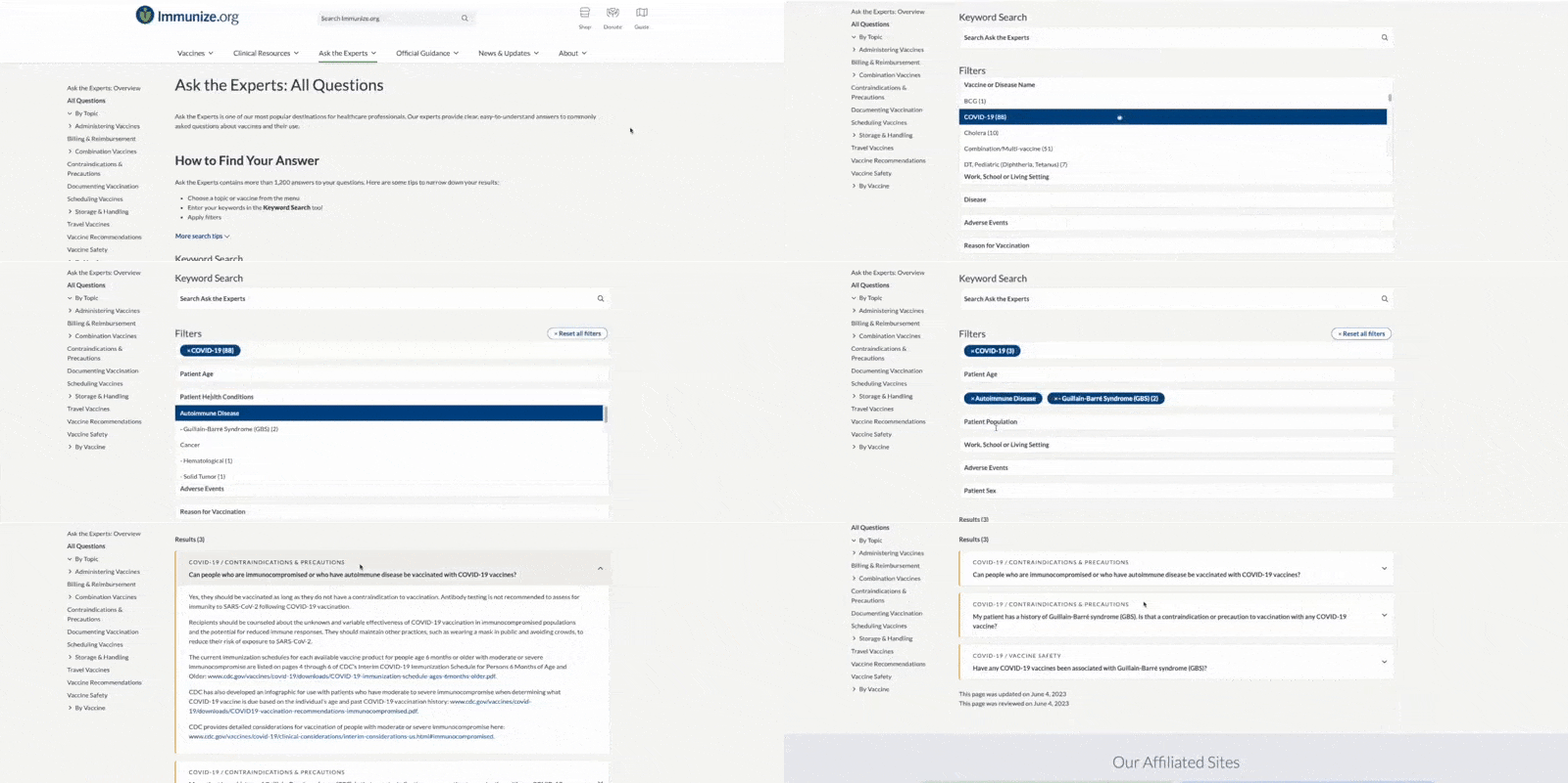
Immunize.org offers a social media program to highlight our educational resources for a broad audience of vaccinators. Our social media channels now feature our most popular printable resources and Ask the Experts questions, as well as announcements important to frontline vaccinators. Please view and share our newest feature, the Ask the Experts Video Series.


Like, follow, and share Immunize.org’s social media accounts and encourage colleagues and others interested in vaccination to do likewise:
- Facebook at ImmunizeOrg
- Instagram at ImmunizeOrg
- LinkedIn at Immunize.org
- YouTube at ImmunizeOrg
Immunize.org offers wallet-sized Lifetime Immunization Record Cards, printed on rip-proof, smudge-proof, waterproof paper designed to last a lifetime. Sold in boxes of 250.

To purchase record cards, please visit the Immunize.org Shop.
Related Link
- Immunize.org: Shop Immunize.org main page
In its June 29 issue, Canadian Medical Association Journal published Fatal Rabies in a Child. This tragic case study highlights the importance of public awareness of the risk of rabies from bats and other animals and, importantly, when to contact public health or a healthcare professional about an unusual exposure. Infected bats may transmit rabies without causing obvious scratches or bite marks. Portions of the article appear below.
The patient’s family reported that, during a visit to a cottage in northern Ontario 19 days before symptom onset, the boy had been awoken by a bat on his nose and mouth. He had swatted the bat off his face; his father had caught the bat in a cooking pot and released it outside. The child had no visible lesions on his face, and his parents did not consider that the bat had behaved erratically. Therefore, they did not seek medical assessment. . . .
. . . By day 5 of admission, his brainstem reflexes were absent. Life-sustaining therapies were withdrawn on day 17 of admission, and he died peacefully with his family at his bedside.
In its June 30 issue, Annals of Internal Medicine published Adverse Events After Same-Day COVID-19 and Influenza Vaccination Versus Influenza Vaccination Alone: A Target Trial Emulation. This study showed same-day coadministration of COVID-19 and influenza vaccines was not associated with an increased risk for adverse events. It evaluated risk using electronic healthcare records from the U.S. Department of Veterans Affairs. The researchers compared adverse events among more than 700,000 participants who received both COVID-19 and seasonal influenza vaccines and 1.8 million who received influenza vaccine only between September 2022 and August 2025. Portions of the abstract appear below.
Safety studies of the COVID-19 vaccine have identified some adverse events. Yet newer variant-updated formulations, along with increased hybrid immunity, may change these risks. Early-era safety data may not reflect experience with updated formulations in more immune-experienced populations. . . .
Same-day coadministration of COVID-19 and influenza vaccines was not associated with an increased risk for adverse events in 3 updated-formulation periods. These findings support the short-term safety of coadministration.
On June 30, KFF released its latest Tracking Poll on Health Information and Trust: Update on Common Vaccine Myths. The findings include:
- Several common vaccine myths remain widespread among the public, including false claims about the measles and COVID-19 vaccines, variously involving autism, adverse events, and alteration of DNA.
- While many have heard of these myths, a smaller number are convinced they are true. Fewer than one in ten adults express ardent belief in each myth, while 31% to 44% say each are “definitely false.” At least half fall in the “malleable middle,” saying each of these claims is either “probably true” or “probably false.”
- Adults who have a relationship with a trusted healthcare provider are less likely than those who don’t have such a relationship to believe or lean toward believing vaccine falsehoods.
- Those who use social media and artificial intelligence (AI) chatbots for health information are more likely to endorse many of these vaccine myths.
- Parents who report skipping or delaying recommended childhood vaccines are consistently at least 25 percentage points more likely than those who keep their children up-to-date to say vaccine myths are “definitely” or “probably true.”
- About three in ten adults fall in a “mixed middle” group, providing a range of true and false answers across the four vaccine myths and lacking certainty on at least half of the false claims. This group may be an important focus for those looking to counter vaccine misinformation and dispel confusion. Black adults, Hispanic adults, Republicans, younger adults, and those without a college degree are all more likely than their counterparts to fall into the “mixed middle” group, as are individuals who go to social media or AI for health information.

Related Link
In its June 30 issue, Lancet published Safety and Efficacy of mRNA Vaccines: A Mechanistic and Public Health Perspective. This review yields a reassuring summary of evidence for the safety and benefits of mRNA vaccine technology. A portion of the summary appears below.
In this Review, we critically examine the safety and efficacy of mRNA vaccines from mechanistic, preclinical, clinical, and public health perspectives. We outline the biological basis of mRNA vaccines, including their transient cytoplasmic expression, lack of genomic integration, and rapid clearance, distinguishing them clearly from other gene therapies. We synthesise evidence on vaccine components, manufacturing quality controls, and regulatory standards that underpin safety, alongside data from randomised trials, post-authorisation surveillance, and active pharmacovigilance systems. We also review real-world effectiveness across age groups, pregnancy, and populations that are immunocompromised, along with the effects on transmission. Last, we address public perception and vaccine confidence, and discuss implications for next-generation mRNA vaccines, including strategies to reduce reactogenicity, improve breadth and durability of immunity, enhance global access, and support sustainable public trust. Together, the accumulated evidence affirms mRNA vaccines as a safe, effective, and adaptable platform with enduring relevance for future infectious disease prevention and public health preparedness, and for the treatment of cancer and autoimmunity.
To learn simple tips and tricks for using our websites efficiently, please register for our next set of Website Office Hours on Wednesday, July 8, at 4:00 p.m. (ET) or Thursday, July 9, at 12:00 p.m. (ET). The same content will be covered in both sessions.
We will open each 30-minute session with a short, live demonstration on navigating our popular public-facing websites, VaccineInformation.org and LetsGetRealAboutVaccines.org. You can submit questions when you register or participate live on Zoom during the session.

Register today for Immunize.org Website Office Hours (content is the same for both):
The archive of previous Website Office Hours content is posted at Immunize.org’s "Webinars & Videos" page.
Mark your calendar for future Immunize.org Website Office Hours.
Decera Clinical Education will host two 45-minute webinars this July.
Current Events in Vaccines: Implications for Vaccine Confidence and Clinical Practice at 2:00 p.m. (ET) on July 14 will explore vaccine uncertainty among patients. Register for this webinar.
A Path to Protection: Purposeful Solutions to Power Up Influenza Vaccine Uptake at 2:00 p.m. (ET) on July 30 will strengthen participants' ability to apply strategies that improve influenza vaccination rates in children and adults. Register for this webinar.
Following each webinar, free CME, CNE, and CPE credits will be provided to attendees.
For more upcoming events, visit our Calendar of Events.