

Thimerosal (a molecule that contains ethyl mercury) is a widely used preservative in medical products. Since 2001, all vaccines routinely recommended for children 6 years of age and younger are thimerosal-free, except for some formulations of inactivated influenza vaccine. Numerous studies have shown that there is no relationship between vaccines, either with or without thimerosal, and the development of autism or other neurologic problems in children.
Immunize.org
Materials for Providers
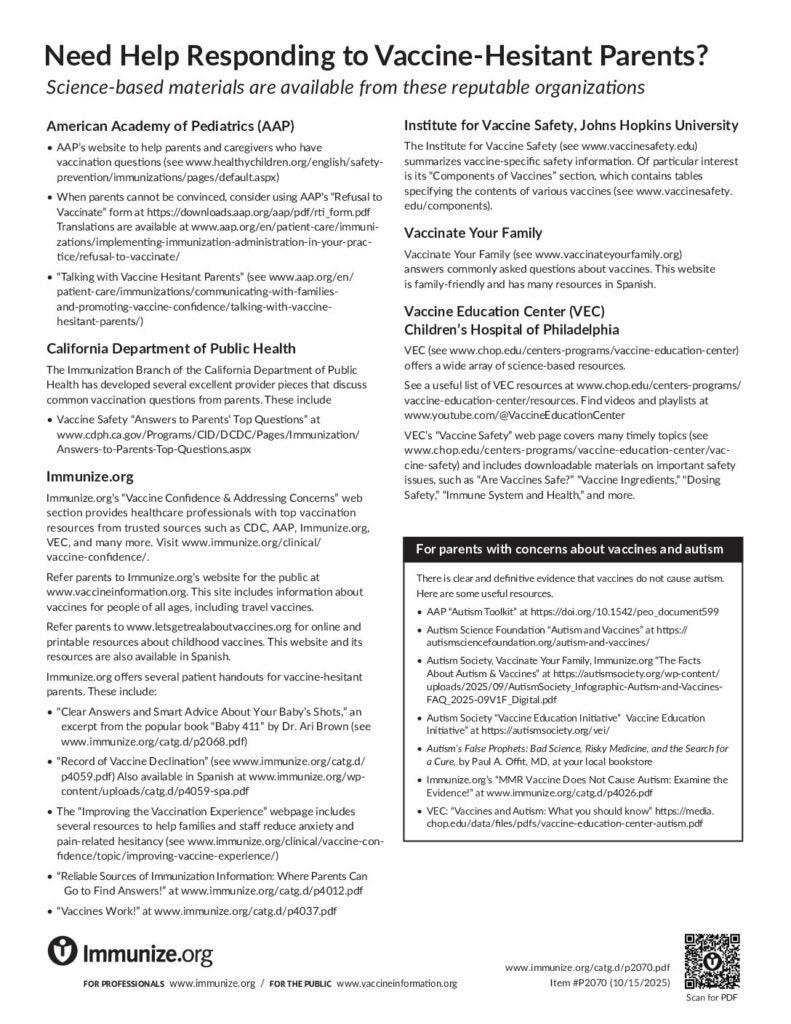
Need Help Responding to Vaccine-Hesitant Parents?
A list of science-based materials available from respected organizations.
Materials for Vaccine Recipients
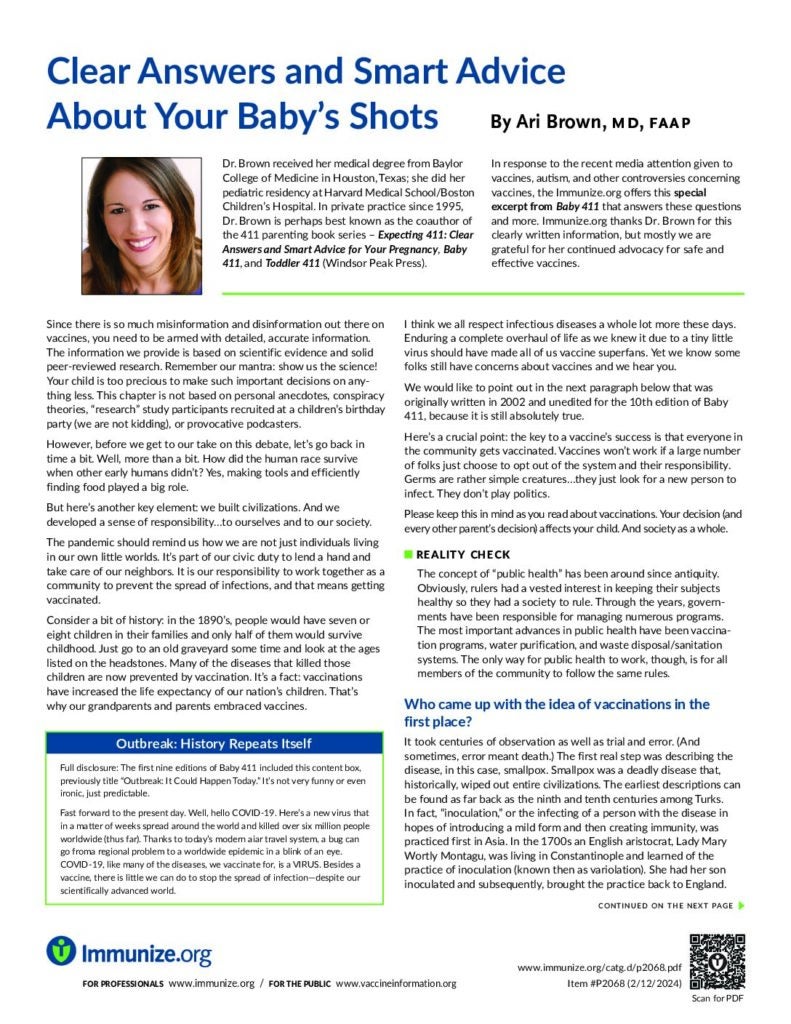
Clear Answers and Smart Advice About Your Baby’s Shots
Written by Dr. Ari Brown, clear answers to parents’ questions about vaccines.

Evidence Shows Vaccines Unrelated to Autism
Co-authored with the Autism Science Foundation, this handout explains to parents why experts say vaccines do not cause autism

Reliable Sources of Immunization Information: Where Parents Can Go to Find Answers!
Handout listing Immunize.org’s top choices for reliable information.
More From Immunize.org
Printable resources and links to partner organizations to help you address hesitancy related to vaccination-related anxiety.
Printable resources designed to help healthcare professionals in all aspects of immunization practice.
Immunize.org experts answer challenging questions about vaccines.
Information sheets produced by CDC that explain both the benefits and risks of a vaccine to vaccine recipients.
Real-life accounts of suffering and loss.
From our affiliated site VaccineInformation.org, information about the importance of vaccines and answers to many common questions.
CDC ∙ FDA ∙ WHO
CDC
Listing of studies, including description, study design, publication date, and objective.
A summary of studies that were conducted by CDC or with CDC’s involvement, including research information about thimerosal.
FDA
A comprehensive resource of information. Includes topics such as thimerosal as a preservative and the rationale for preservatives in vaccines.
Trusted Organizations
American Academy of Pediatrics (AAP)
A collection of articles that show there is no link between vaccines and autism.
Children’s Hospital of Philadelphia, Vaccine Education Center (VEC)
A summary of the evidence showing that, while some things do cause autism, mercury in vaccines isn’t one of them. A Spanish-language version is also available.
A summary of studies that show no link between thimerosal in vaccines and autism.
National Academy of Medicine
The National Academy of Medicine is an impartial group of the world’s leading experts that advises Congress on science issues.
A 2012 analysis of more than 1,000 research articles concludes that few health problems are caused by or clearly associated with vaccines.
A 2002 study from the National Academy of Medicine, an impartial group of the world’s leading experts that advises Congress on science issues.
Based on the review of clinical and epidemiological studies, a 2012 study concludes the thimerosal and the MMR vaccine are not associated with autism.
Vaccinate Your Family
Easy-to-understand answers to questions like is there mercury in vaccines? Why is thimerosal (ethylmercury-based preservative) in vaccines?
Details on various thimerosal and autism studies, includes reference, lead researcher, objective, study method/design, conclusion, and funding.
Vaxopedia
Author Vincent Iannelli, MD, explains that thimerosal is a preservative and was removed from vaccines starting in 1999 and most teens today have had little or no exposure to thimerosal from vaccines.
Additional Resources
In this study of managed care organization members, prenatal and early-life exposure to ethylmercury from thimerosal-containing vaccines and immunoglobulin preparations was not related to increased risk of ASDs. (Pediatrics, 2010)
Exposure guidelines based on oral methyl mercury in adults may not be correct when assessing children. (Pediatrics, 2008)
Childhood thimerosal-containing vaccines do not produce ASD-like neuropathology or behavioral changes in the nonhuman primate. (Proceedings of the National Academy of Sciences of the United States of America, 2015)
This study concluded they could not support the causal association between early exposure to mercury from thimerosal-containing vaccines and immune globulins and deficits in neuropsychological functioning at the age of 7 to 10 years. (New England Journal of Medicine, 2007)
This study concluded that there is no convincing evidence that MMR vaccination and increasing thimerosal dose were associated with an increased risk of ASD onset. (Vaccine, 2016)
Author Maureen Connolly on why parents don’t need to worry about mercury in childhood vaccines. (Parents magazine, October 3, 2005)
Author Lauren Gelman reviews countless studies that have shown no link between vaccines and an increased risk of autism spectrum disorder. (Parents magazine, September 2, 2020)
Videos
Paul A. Offit, MD, explains the different types of mercury and how they are processed in the human body. From the Children’s Hospital of Philadelphia.
Vaccine Questions?
Email CDC at nipinfo@cdc.gov